



 5 Min Read
You just sat through another budget review. Someone asked why the Q3 campaign was underdelivered. You had data, plenty of it, but none of it told you why fast enough to course correct while it still mattered.
Sound familiar?
This is the reality for most marketing leaders in 2026. Not a lack of data. Not a lack of tools. A lack of decisions made at the right time, with the right evidence, connected to real business outcomes.
AI is changing that dynamic completely.
The marketers pulling ahead this year are not the ones with the biggest budgets. They are the ones making better calls, faster, with AI doing the heavy analytical lifting behind every move.
Why Marketing Decisions Are Still Too Slow
Boards demanding proof of ROI before the campaign even wraps up.
The pressure on marketing leaders has never been this specific.
And yet, most teams are still flying with instruments that were built for a different era. Spreadsheets stitched together across regions. Attribution models that credit the last ad someone clicked before converting. Planning cycles that take weeks to produce insights that are already outdated by the time they land in an inbox.
Traditional Marketing Mix Modeling takes 8 to 12 weeks to deliver results. The campaign is already over. The budget is already gone. The window to fix anything has closed. Last-click attribution is no better. It hands all the credit to the final touchpoint and makes every channel that built awareness, consideration, and intent completely invisible.
McKinsey data points to companies with faster decision cycles outperforming competitors by up to 25% in revenue growth.
The gap is between data and a decision, knowing something happened and understanding it early enough to do something about it.
That is the problem AI is now built to solve
How AI Is Transforming Marketing Effectiveness (5 Core Shifts)
Five specific shifts in how marketing effectiveness decisions get made, measured, and acted on.
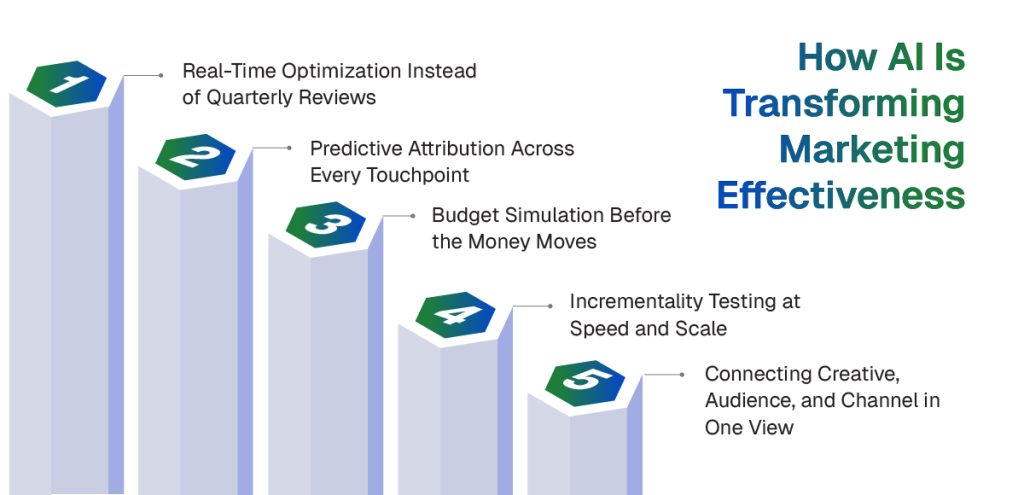
1. Real-Time Optimization Instead of Quarterly Reviews
Most marketing teams review performance monthly at best. By the time data is pulled, formatted, and discussed, the moment to act has already passed.
AI does not wait for a meeting.
It continuously reads signals across every channel:
- Digital campaigns underdelivering on reach in a key region
- A channel burning through budget at twice the expected rate with half the conversions
- A competitor promotion pulling share where your spend is already thin
What changes: Budget reallocation mid-campaign becomes standard practice, not a crisis response. Teams that once moved in quarters are now moving in days.
2. Predictive Attribution Across Every Touchpoint
Last-touch attribution has one job: credit whoever was last. The problem is that job is the wrong one. A customer who converts after clicking a retargeting ad did not appear out of nowhere. Before that click, they:
- Watched a video
- Read a comparison article
- Saw an out-of-home placement on their commute
- Opened an email three weeks before they were ready to buy
AI maps that entire journey. It connects online behaviour with offline purchase signals and assigns weighted credit across every meaningful interaction.
3. Budget Simulation Before the Money Moves
What if you could model the revenue impact of every budget decision before committing it?
AI-powered scenario planning makes that possible. Marketing leaders can now simulate:
- Shifting 15% from linear TV to connected TV
- Increasing trade spend in one region while pulling back in another
- Reducing paid search in a mature market and redirecting to brand
Each simulation shows projected ROI impact, channel-level outcomes, and trade-offs — before a single dollar moves.
The boardroom shift: Instead of defending past decisions with lagging data, marketing leaders walk in with forward-looking evidence. Decisions get made faster. Budget conversations become strategic, not defensive.
4. Incrementality Testing at Speed and Scale
Let’s start with a simple definition.
Incrementality is the extra sales that happen because of your campaign, above what would have happened anyway.
Here is a straightforward example:
- Your brand sells 10,000 units a week with no campaign running
- You launch a paid media campaign and sales rise to 13,000 that week
- The incremental impact is 3,000 units
- The remaining 10,000 would have happened with or without your campaign
Without measuring this, brands keep funding campaigns that are simply capturing demand that already existed. Not creating new growth. Just taking credit for it.
The Old Way
Most teams could only run one or two incrementality tests a year because the process was slow and expensive:
- Tests ran for 12 to 16 weeks to get reliable results
- Large holdout groups were required, locking away budget that could not be used for active marketing
- Manual analysis took weeks after the test had already ended
- By the time results came in, the campaign was over and learnings rarely fed back into the next decision
The AI Way
- Smarter experiment design means smaller, more precise holdout groups
- Tests complete in 3 to 4 weeks instead of months
- Results feed directly back into live campaigns while they are still runniMultiple tests run simultaneously across channels and regions
5. Connecting Creative, Audience, and Channel in One View
For most teams, creative performance, audience data, and channel strategy live in completely separate systems, managed by separate teams, reviewed in separate reports.
AI pulls all of that into one unified model. It surfaces patterns that siloed reporting would never catch:
- Which creative format drives the highest consideration lift among a specific audience on a specific channel
- Which message sequence moves a high-value customer from awareness to purchase fastest
- Where brand and performance budgets are working against each other instead of compounding
The result: Brand building and performance marketing stop being treated as opposing forces. They start functioning as one connected system.
The Data Foundation Underneath It All
Let’s be direct about something most AI vendors will not tell you upfront.
The most sophisticated marketing AI model in the world will produce unreliable, misleading, and sometimes damaging outputs if the data feeding it is fragmented, inconsistent, or incomplete.
AI is only as good as what it learns from. Full stop.
Yet this is where most implementations go wrong. Brands invest in AI tools before they have fixed the data problem underneath. The result is fast answers to the wrong questions, built on shaky foundations.
The Most Common and Costly Mistake
Skipping the foundation and jumping straight to the AI layer.
It happens more than it should. The pressure to show innovation, the appeal of a polished AI product demo, the belief that the data issues can be fixed later. They cannot. Or rather, they can, but only after significant rework, cost, and erosion of trust in the outputs.
The brands getting the most out of AI-driven marketing effectiveness in 2026 built their data foundation first. They treated it as a strategic asset, not an IT project.
Get the foundation right. Everything built on top of it works better.
QUICK READ: Generative AI’s Role in Making Unstructured Data Valuable
How Heliosz.AI’s Marketing Effectiveness Accelerator Brings This Together
Everything covered in this blog, real-time optimization, predictive attribution, budget simulation, incrementality testing, clean data foundations, points to one operational need.
A system purpose-built to connect all of it. That is exactly what the Heliosz.AI Marketing Effectiveness Accelerator is designed to do.
Built for One Job: Marketing ROI That Is Actually Actionable
Most analytics platforms were built for reporting. They tell you what happened, present it in a dashboard, and leave the interpretation to you.
This accelerator is built for decisions.
It is an AI-powered engine designed specifically around marketing effectiveness measurement, not adapted from a general analytics tool, not bolted onto an existing BI platform. Built from the ground up for the problem marketing leaders are actually trying to solve.
Closing Thoughts
Here is what the best-performing marketing teams in 2026 have in common. It is not the biggest budgets. It is not the most channels. It is not even the most sophisticated creative.
It is the ability to make better decisions, faster, with evidence that connects every marketing move to a business outcome.
AI does not replace the judgment that comes from years of understanding your category, your customer, and your brand. That judgment still matters. What AI does is give it sharper evidence to work with, at a speed that was simply not possible before.
The brands pulling ahead right now are not outspending their competitors. They are outthinking them, with systems that turn data into decisions before the window closes.
Ready to Make Smarter Marketing Decisions Faster?
The Heliosz.AI team works with marketing and data leaders to build marketing effectiveness engines that connect spend to outcomes, fast.
Talk to the team about what this looks like for your business.