 5 Min Read
Businesses are constantly seeking ways to make smarter, faster, and more accurate decisions. One of the most groundbreaking tools driving this transformation is Artificial Intelligence (AI). AI is no longer just a futuristic concept, it’s actively reshaping how companies operate, compete, and grow.
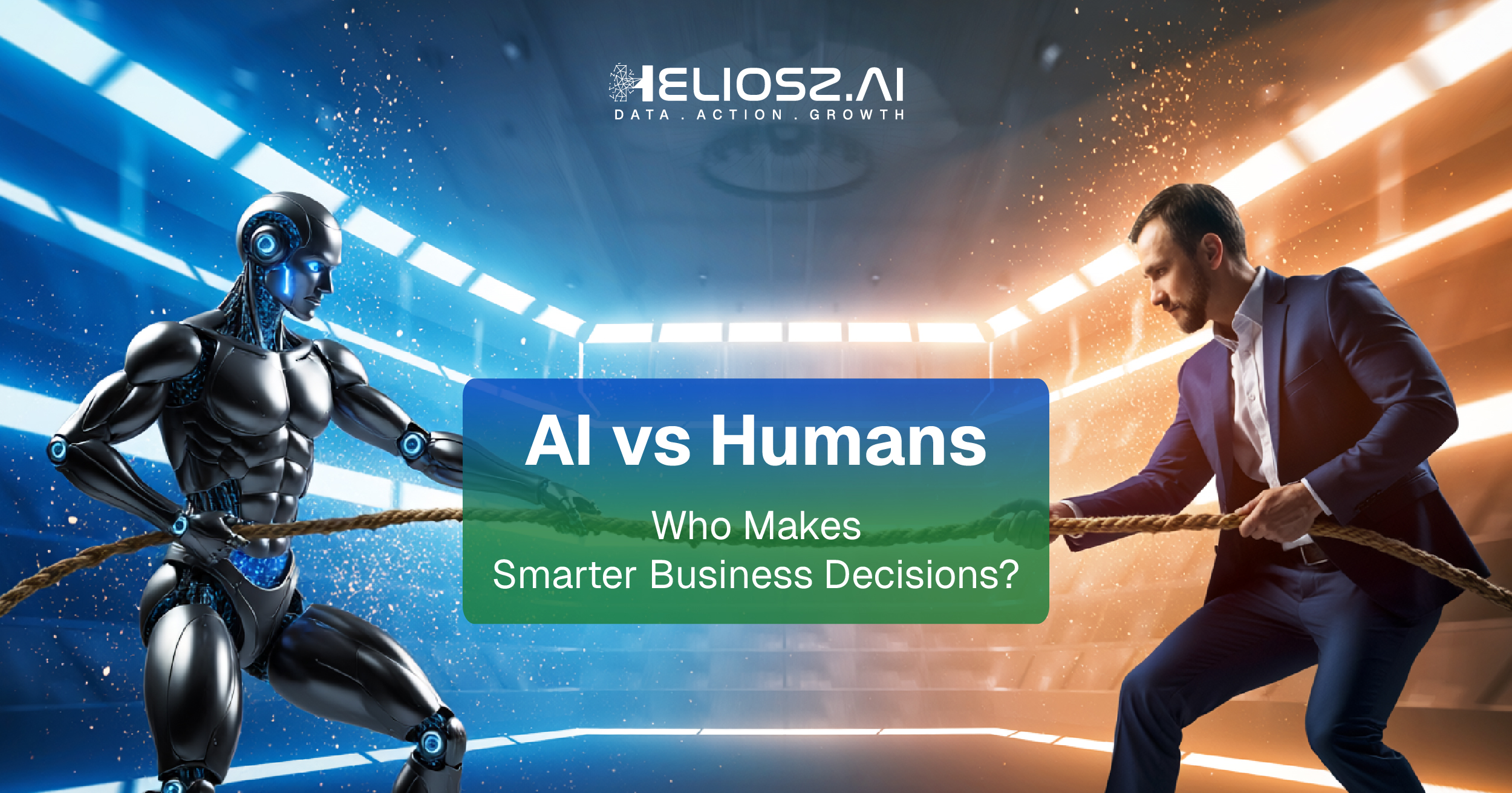
As AI technologies continue to improve, a growing question has emerged: Can AI make better business decisions than humans? While AI excels in analyzing data and identifying patterns, it also raises concerns about judgment, ethics, and emotional intelligence. In this article, we explore how AI is used in business decision-making, its key advantages, and how it compares to human decision-making capabilities.
What is AI in Business Decision-Making?
Artificial Intelligence in business decision-making refers to the use of intelligent algorithms and machine learning models to analyze data, recognize patterns, and provide actionable insights. These systems mimic human intelligence but operate on a scale and speed no human can match.
AI can support or even automate decisions in areas like marketing, finance, operations, HR, and customer service. It leverages large datasets (often called “big data”) and real-time inputs to make decisions that are data-driven, consistent, and often more efficient than those made by humans alone.
How AI is Used in Business Decisions?
Below are some of the key areas where AI is transforming decision-making, with each application serving a unique function in business operations.
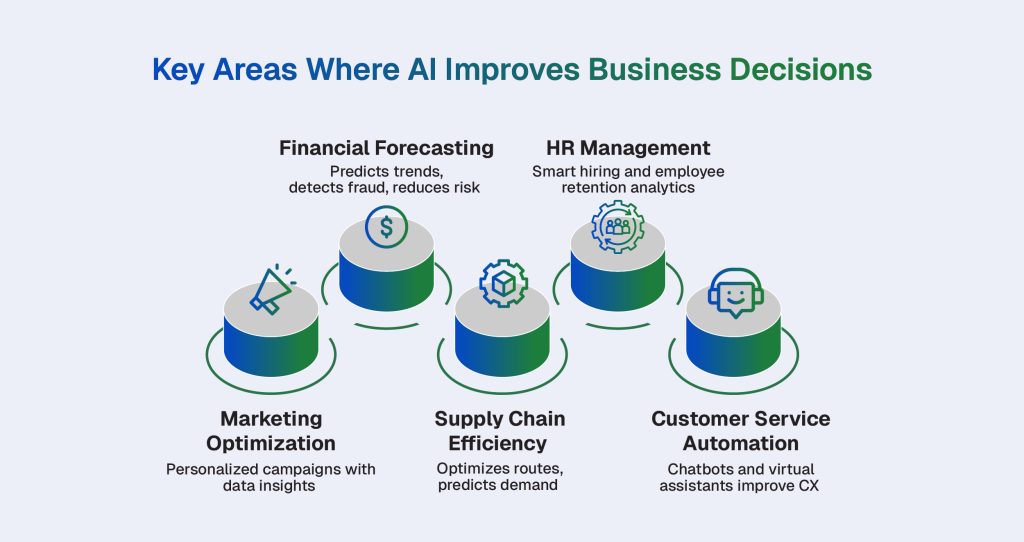
Data-Driven Marketing
AI enables marketers to move beyond intuition and make decisions based on customer behavior, preferences, and real-time analytics. Tools like predictive analytics and customer segmentation help businesses target the right audience with personalized messages, increasing engagement and conversion rates.
AI also powers programmatic advertising, where algorithms decide which ads to show to which users at the perfect moment, maximizing ROI with minimal human input.
Financial Forecasting
AI is revolutionizing finance by automating risk assessment, budgeting, and forecasting. Machine learning models can detect anomalies, assess creditworthiness, and predict market trends far more accurately than traditional methods.
Banks and financial institutions also use AI for fraud detection, identifying suspicious patterns and transactions in real time to prevent financial loss.
Supply Chain Optimization
AI helps companies predict demand, manage inventory, and optimize logistics routes. By analyzing historical sales data, weather patterns, and market trends, AI can forecast supply chain disruptions and recommend timely solutions.
This leads to reduced operational costs, minimized stockouts or overstock, and a smoother end-to-end supply chain process.
HR and Talent Management
AI is transforming HR with tools that streamline recruitment, performance evaluation, and employee retention. Resume screening software filters candidates based on skill match, while sentiment analysis tools assess employee satisfaction through surveys or internal communications.
Additionally, AI can predict employee attrition, enabling HR teams to take proactive measures to improve retention.
Customer Service Automation
AI-powered chatbots and virtual assistants are becoming the first point of contact in customer service. These systems provide instant responses, solve common issues, and free up human agents to handle more complex queries.
Natural Language Processing (NLP) allows AI to understand customer intent and deliver relevant support — enhancing both speed and customer satisfaction.
Advantages of AI Over Human Decision-Making
AI offers several key benefits that make it a powerful tool in business decision-making. Let’s look at the most impactful advantages.
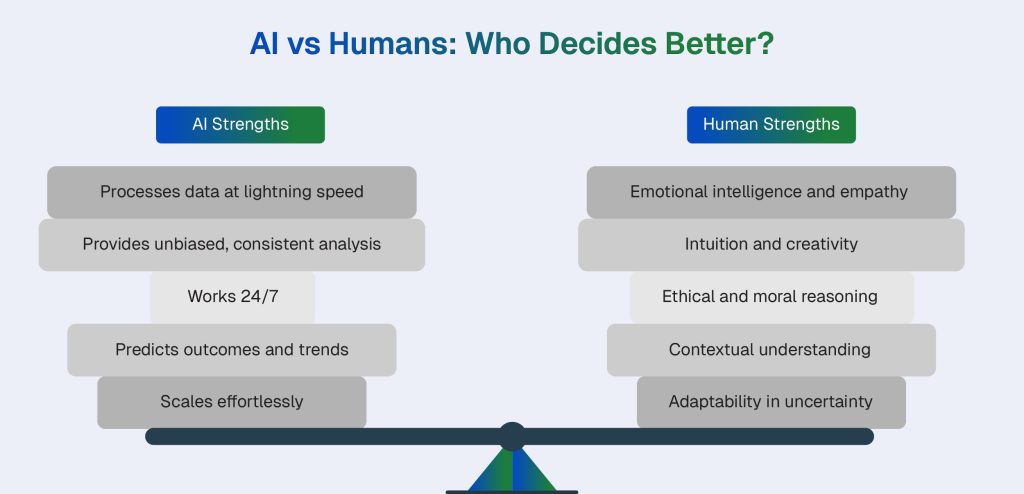
Speed and Efficiency
AI processes massive volumes of data in seconds, far outperforming humans in terms of speed. This allows businesses to make real-time decisions, whether it’s approving a loan application, adjusting a marketing campaign, or detecting a cybersecurity threat.
Unbiased Analysis
While human decisions are often influenced by emotions, experiences, or cognitive biases, AI provides objective analysis. It evaluates information based purely on logic and data, leading to more consistent and fair outcomes, provided the data itself is unbiased.
24/7 Operational Capability
AI systems don’t sleep, take breaks, or require holidays. They offer round-the-clock productivity, ensuring customer support, transaction monitoring, and other critical tasks continue without interruption. This is especially valuable for global businesses that operate across time zones.
Predictive Power
AI’s ability to predict trends, customer behavior, and risks gives businesses a major competitive edge. For example, retail companies can forecast product demand, while financial firms can anticipate market shifts. These predictive capabilities allow businesses to act proactively, rather than reactively.
Scalability
Unlike human teams, AI can easily scale to handle more data, tasks, or customers without a drop in performance. Whether it’s processing thousands of transactions or answering millions of customer queries, AI handles volume effortlessly — helping businesses grow sustainably.
Limitations of AI in Decision-Making
While Artificial Intelligence offers speed, scalability, and accuracy, it is not without flaws. Businesses need to understand these limitations to avoid over-reliance on AI-driven decisions. Below are the key challenges that AI faces in decision-making.
- Lack of Emotional Intelligence and Human Intuition
AI systems cannot replicate empathy, creativity, or intuition — qualities that are often essential in leadership, negotiations, or customer relations. For example, making decisions about employee well-being, resolving conflicts, or developing innovative ideas requires a human touch that AI cannot provide.
- Dependency on Data Quality
AI is only as effective as the data it is trained on. Inaccurate, incomplete, or biased data can lead to flawed decisions. For instance, if an AI recruitment tool is trained on biased hiring data, it may unintentionally replicate discrimination in candidate selection.
- Ethical and Moral Concerns
AI often prioritizes efficiency over ethics. In real-world scenarios, decisions involve moral responsibility- something AI cannot fully grasp. For example, in healthcare, deciding how to allocate limited resources cannot rely solely on algorithms without considering human values.
- Limited Contextual Understanding
AI can analyze facts and numbers but struggles to interpret context, cultural nuances, and complex social dynamics. A customer service chatbot may respond accurately to simple queries but fail to understand sarcasm, frustration, or emotional cues in customer interactions.
- Transparency and the “Black Box” Problem
Some AI models, especially deep learning systems, make decisions that are difficult to explain even by their developers. This lack of transparency- often called the black box problem, raises concerns for industries like finance, healthcare, and law, where decision-making must be justified and accountable.
- High Implementation and Maintenance Costs
Developing and maintaining AI systems can be expensive. Beyond initial investments, businesses must constantly update algorithms, ensure data security, and monitor AI performance to avoid errors. Smaller organizations may struggle to achieve a good return on investment.
Heliosz: AI-Powered Solutions for Smarter Business Decisions
At Heliosz, we believe the future of business lies in combining human intelligence with AI-driven insights. Our AI-powered solutions like Agentic AI services and GenAI solutions help businesses:
- Analyze data faster and more accurately
- Optimize operations across departments
- Improve customer experiences with intelligent automation
- Make smarter, data-backed decisions with confidence
Whether you’re looking to streamline processes, forecast trends, or enhance customer engagement, Heliosz provides custom AI solutions designed to scale with your business.
Conclusion
So, can AI make better business decisions than humans? The answer is- it depends.
AI undeniably outperforms humans in areas that involve data analysis, speed, and scalability. It enhances efficiency and reduces errors in routine or predictive tasks. However, human decision-making still plays a crucial role when it comes to creativity, ethical judgment, and emotional intelligence- areas where AI still falls short.
The future of business decision-making lies not in choosing between humans or AI but in combining their strengths. By embracing AI-human collaboration, companies can unlock smarter, faster, and more balanced decision-making processes, and secure a stronger competitive advantage in the digital age.
Ready to unlock the power of AI in your decision-making?
Contact Heliosz today and start transforming your business with AI-driven intelligence.