 5 Min Read
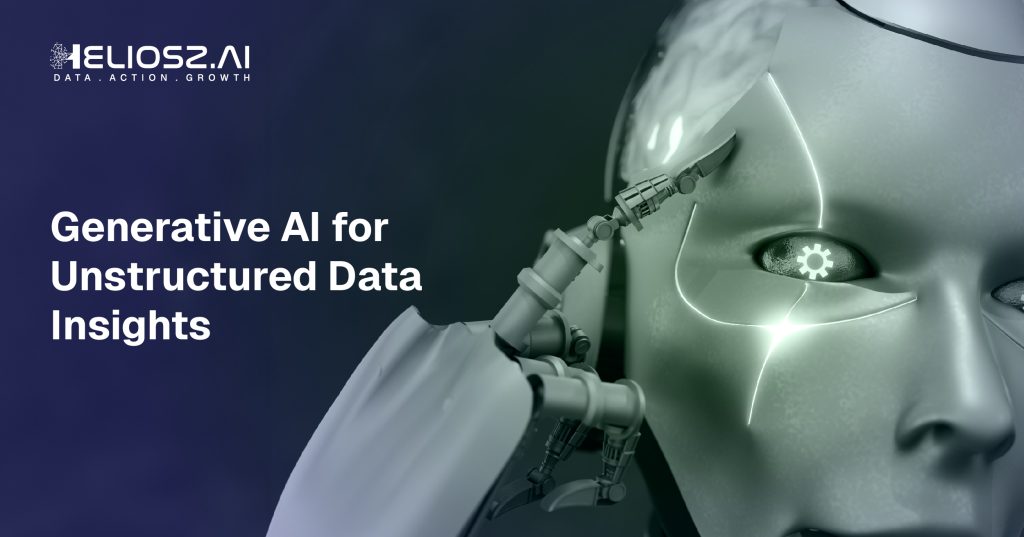
Organizations are increasingly grappling with the complexity of unstructured data. From emails and social media posts to videos, images, and audio files, unstructured data accounts for the vast majority of information generated and stored globally. Unlike structured data, which fits neatly into rows and columns of a database, unstructured data lacks a predefined format, making it difficult to analyze and derive insights from using traditional approaches. This poses significant challenges for businesses looking to unlock actionable insights hidden within these data sources.
Enter generative AI, a groundbreaking technology that is redefining the way we approach unstructured data. Generative AI models, such as large language models and image synthesis tools, can process unstructured data with incredible efficiency, extracting valuable patterns and generating meaningful outputs. By doing so, generative AI is transforming unstructured data from a challenge into an invaluable resource for organizations across industries. This article explores how generative AI works, its capabilities, and how it is revolutionizing unstructured data processing to create new opportunities for innovation and growth.
Understanding Unstructured Data
Unstructured data refers to information that does not adhere to a fixed schema or format. Unlike structured data, which is organized into clearly defined rows and columns in relational databases, unstructured data is heterogeneous, diverse, and often messy. Examples of unstructured data include text documents, videos, images, social media posts, emails, sensor data, audio recordings, and more.
One defining characteristic of unstructured data is its complexity. This type of data often contains a mix of formats, languages, and media types, making it challenging to analyze using traditional data processing techniques. For instance, consider an email thread that includes text, attachments, embedded images, and hyperlinks. Each component requires a different approach to extract meaning.
Why Unstructured Data Matters?
The challenges posed by unstructured data extend beyond its diversity. Due to its lack of a consistent structure, traditional data analytics tools and techniques struggle to process it effectively. Organizations often face difficulty in:
- Organizing and classifying unstructured data for storage.
- Extracting meaningful insights or trends from large volumes of unstructured information.
- Integrating unstructured data with structured datasets for comprehensive analysis.
Despite these hurdles, unstructured data holds immense potential value. Within text-based unstructured data, for example, there may be critical insights into customer sentiment, emerging market trends, or internal operational inefficiencies. Similarly, image or video-based unstructured data can reveal patterns relevant to manufacturing quality control, security monitoring, or medical diagnostics. The challenge lies in unlocking these insights, and that’s where generative AI comes in.
How Generative AI Makes Unstructured Data Valuable
Generative AI is uniquely positioned to address the challenges posed by unstructured data. Its ability to process, analyze, and create from diverse data sources enables organizations to extract meaningful insights that were previously inaccessible.
Here are several ways in which generative AI is revolutionizing unstructured data processing:
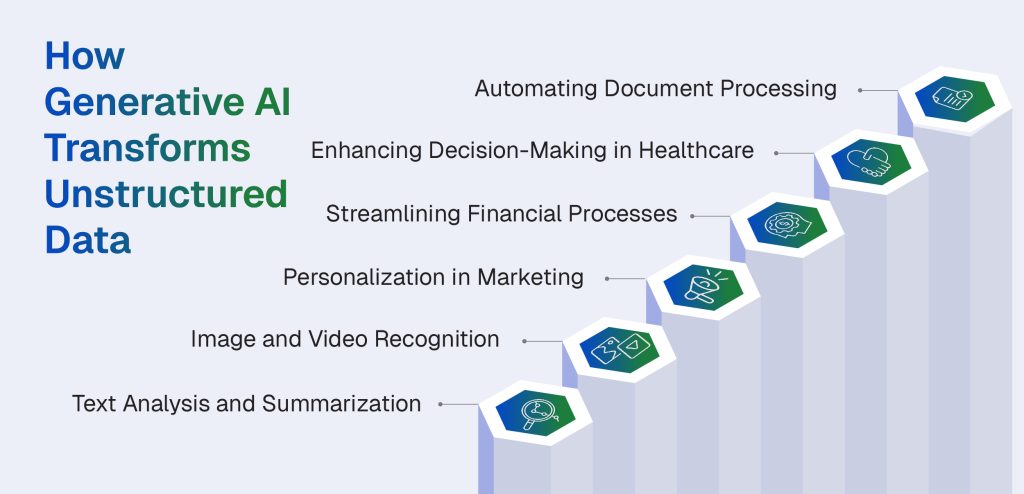
- Text Analysis and Summarization
Unstructured text data, such as customer feedback, legal documents, and social media posts, contains a wealth of information that can be difficult to analyze manually. Generative AI models excel at understanding natural language and can extract key themes, summarize lengthy documents, and even identify sentiment within text. For example, a company might use generative AI to analyze thousands of product reviews and identify common customer concerns or preferences.
- Image and Video Recognition
In fields like healthcare and manufacturing, unstructured image and video data can be a goldmine of actionable insights. Generative AI models trained on medical imaging datasets, for instance, can identify early signs of diseases like cancer with greater accuracy than human radiologists. Similarly, in quality control processes, AI-powered image recognition tools can detect minute defects in manufacturing outputs by analyzing video feeds.
- Personalization in Marketing
Generative AI is enabling businesses to create personalized marketing strategies based on insights derived from unstructured customer data. By analyzing behavior patterns across emails, social media interactions, and website visits, AI models can generate targeted content, product recommendations, and messaging tailored to individual customers.
- Streamlining Financial Processes
The finance industry generates massive amounts of unstructured data, including transaction records, regulatory filings, and risk assessment reports. Generative AI can process this data to extract key insights, identify patterns of fraud, and even automate the generation of financial summaries. For instance, banks can use AI tools to monitor unstructured customer communication for signs of dissatisfaction or risk factors.
- Enhancing Decision-Making in Healthcare
Healthcare providers often deal with a deluge of unstructured data, including patient records, medical imaging, and clinical trial data. Generative AI helps synthesize this information into actionable insights. For example, AI-powered systems can analyze a combination of doctor’s notes and lab results to recommend personalized treatment plans or predict patient outcomes.
- Automating Document Processing
Organizations in sectors like law, insurance, and government routinely manage enormous amounts of unstructured data in the form of contracts, legal filings, or claims. Generative AI models can process these documents to extract critical clauses, identify anomalies, or generate summaries, saving time and reducing manual workload.
Heliosz for Successful Implementation of GenAI
If you’re exploring how to put generative AI to work on your unstructured data, Heliosz can help. We work closely with teams to design and implement practical, effective GenAI solutions that fit real business needs—no hype, just results.
Why Heliosz?
- Proven expertise in GenAI deployment across industries
- Scalable, secure, and enterprise-grade AI solutions
- Integration with existing data infrastructure
- Fast-track implementation and measurable ROI
Contact us today to schedule a consultation or demo.
Conclusion
Generative AI represents a turning point in the way we approach unstructured data. Its ability to process, understand, and generate from complex, diverse datasets has opened up new avenues for extracting value from information that was previously underutilized. By automating tasks like text analysis, image recognition, and personalized content creation, generative AI is enabling organizations to tap into the untapped potential of unstructured data.
The impact of generative AI extends across industries, from improving patient care in healthcare and enhancing customer experiences in marketing to driving efficiency in financial operations and beyond. As businesses increasingly adopt AI-driven solutions, the ability to effectively leverage unstructured data will become a critical competitive advantage.