Email:
inquiry@heliosz.ai
Email:
inquiry@heliosz.ai Phone: +1 (332) 255-6223



 5 Min Read
Most marketing teams are making decisions on data they do not fully trust. They know it. They have learned to live with it.
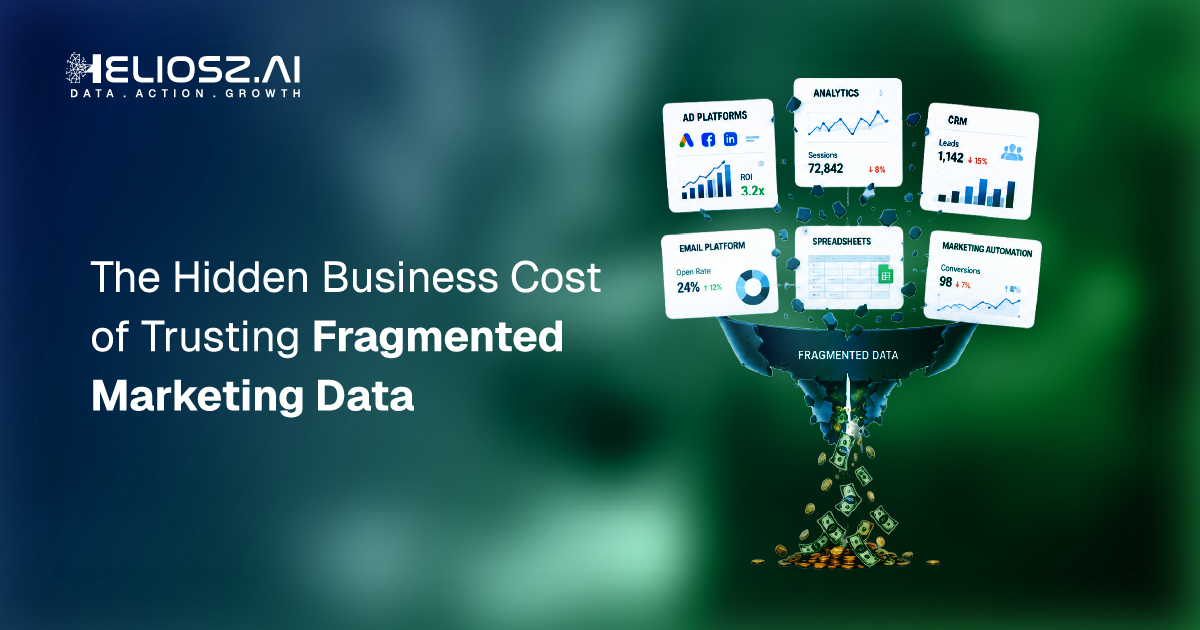
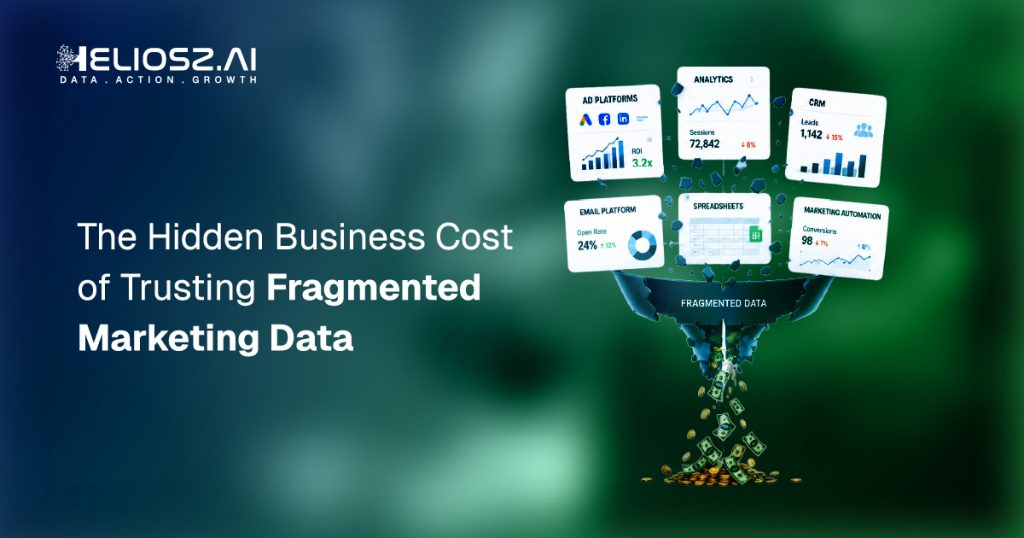
The ad platform says the campaign is performing. Analytics says it is flat. The CRM says the leads are not converting. All three are technically correct. None of them are telling the full story. And somewhere in the middle of those three versions of reality, budget decisions are being made, campaigns are being cut, and strategies are being built on a foundation that nobody has actually verified.
That quiet acceptance is the hidden cost of fragmented data and most leaders are only beginning to realize how much it is actually costing them.
What Is Fragmented Marketing Data?
In marketing, fragmented data refers to a condition where critical business metrics campaign performance, lead data, customer acquisition cost, conversion rates are scattered across multiple disconnected tools like ad platforms, CRMs, analytics software, and marketing automation systems, each operating on different definitions, attribution windows, and reporting logic. Every platform is technically functioning, but no single platform is telling the complete story.
QUICK READ: What Breaks First Without Unified Marketing Data
How Every Stack Ends Up Broken
Nobody plans a fragmented data environment. It builds itself.
Google Analytics first, because everyone does. Then a CRM for sales. A paid social tool, a marketing automation platform, a product analytics layer. Each approved for a legitimate reason. Twelve months later you have nine platforms connected through native integrations, Zapier workflows, and a manual CSV export someone set up two years ago that nobody has touched since.
Now every platform tracks behaviour its own way. Attribution windows differ. Conversion definitions differ. Even “session” means something different depending on where you look. The data is not wrong exactly. It is just measuring different things and calling them the same name.
ALSO READ: Marketing Forecasting Tools
The Costs That Never Show Up on a Budget Line
A well-funded B2B SaaS client came to us with four dashboards showing four different customer acquisition costs for the same quarter. Two made their paid campaigns look like a liability. Two made them look like the best growth channel they had.
Marketing was defending budget using the favorable number. The CFO was building a case to cut it using the unfavorable one. Both were working hard, both thought they were right. This had been running quietly for almost a year.
Mid-sized companies lose $200,000 to $850,000 annually through redundant tools, duplicate subscriptions, and misallocated ad spend. But the visible losses are just the beginning:
- Decisions delayed two weeks because nobody would commit to numbers they did not trust.
- Campaigns cut mid-flight because leadership lost confidence in the reporting.
- CMOs spending 30% of their time building narrative around data instead of making moves.
- Senior analysts burning 40 to 50% of their hours on reconciliation, not strategy, not analysis, just explaining why this number is different from that one.
What Fragmentation Does to Speed?
Fast companies win on iteration speed. You run a campaign, read the signal quickly, reallocate toward what works. That feedback loop, when clean, compounds over months into a significant gap between you and a slower competitor.
Fragmented data breaks that loop entirely.
Budget shifts that should take two days take two weeks. A high-performing channel goes unrecognized because it looks flat in the dashboard your CMO checks but shows strong assisted conversions in a tool only one analyst uses. Every week your team spends arguing about data is a week your competitor spent acting on theirs.
QUICK READ: Marketing Budget Optimization
The Fix: Connect First, Replace Never
Solving fragmentation means connecting what you already have.
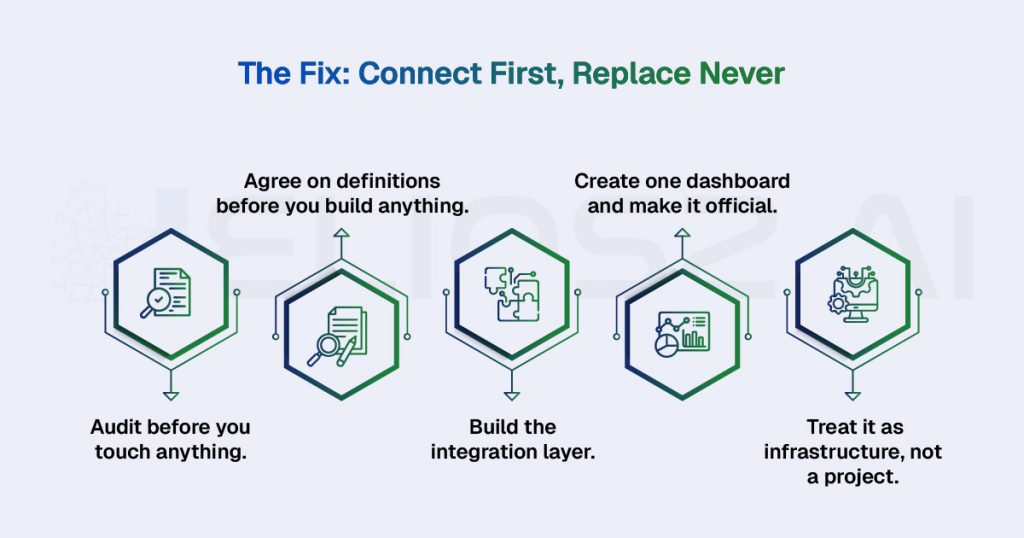
Audit before you touch anything.
Map every tool, data source, and integration currently running. Two weeks, a small cross-functional team. Find exactly where metrics conflict and why. You cannot fix what you have not named.
Agree on definitions before you build anything.
What is a lead? What is your official CAC? Get marketing, sales, and finance to sign off on a shared glossary. Without this, even the best infrastructure produces conflicting outputs because you are feeding it ambiguous inputs.
Build the integration layer.
A Customer Data Platform, reverse ETL tooling, or a centralized data warehouse connects your existing platforms without replacing them. Start with the two connections that drive most decisions: ad platforms to CRM, CRM to analytics.
Create one dashboard and make it official.
Not the most detailed view. The agreed view. The one finance signs off on. The one presented to the board without question. Start with two or three channels, prove the accuracy, then expand.
Treat it as infrastructure, not a project.
New tools get added. Definitions drift. Build a quarterly review into the process and assign ownership of data quality the same way you assign ownership of pipeline. Companies that do this see 20 to 40% improvement in marketing efficiency within the first year.
One Truth Beats a Hundred Dashboards
The marketing teams winning right now are the ones who built a single trusted picture of reality and made every decision from it.
At Heliosz, this is the problem we have built our practice around. We help marketing leaders unify fragmented data environments, build governance that holds under real organizational pressure, and create a source of truth their teams can actually move fast with.
If your team is still having the wrong conversation every Monday morning, let us talk.
What is the biggest data conflict slowing your team down right now?
Frequently Asked Questions: Fragmented Marketing Data
What is the hidden cost of fragmented marketing data?
Beyond duplicate tool subscriptions, it costs organizations in delayed decisions, misallocated ad spend, and senior talent spending 40–50% of their time reconciling numbers instead of driving strategy.
Why does marketing data fragmentation happen?
It builds gradually one tool approved at a time until teams are running multiple platforms on conflicting metric definitions with no single agreed source of truth.
How does fragmented marketing data affect decision-making speed?
Budget shifts that should take two days take two weeks, and high-performing channels go unrecognized because they look flat in one dashboard but show strong results in another.
How do you fix fragmented marketing data?
Audit every tool, agree on shared metric definitions across teams, build a central integration layer, and create one official dashboard that finance and leadership work from.
What is a single source of truth in marketing?
One unified dashboard where all key metrics are consistently defined and signed off on by marketing, sales, and finance giving every team the confidence to act on the same numbers.