


 5 Min Read

Your marketing budget is leaking. You just can’t see where.
Every morning, the dashboards look strong. Meta reports 40 sales. Google reports 60. But when you check actual revenue, the numbers don’t add up. This is the tracking problem most teams are dealing with now. Every platform claims credit, but none account for overlap or wasted spend.
You cannot scale decisions on inflated numbers. More budget will not fix this. Better allocation will.
This is where marketing budget optimization becomes a decision system, not a reporting task. The goal is simple. Find where money is being misallocated, correct it, and move spend toward what actually drives results.
Did you know? Marketing budget optimization is never a one-time task, it’s an ongoing cycle of auditing, testing, and reallocating spend to make every dollar work smarter than the one before it.
What is Marketing Budget Optimization?
Marketing Budget Optimization (aka Marketing spend optimization) is the strategic process of analyzing, adjusting, and reallocating budget to high-performing channels to maximize Return on Investment (ROI) and minimize waste. It involves using data analytics and AI to shift spending toward campaigns that drive actual revenue, rather than just vanity metrics.
“Half the money I spend on advertising is wasted; the trouble is, I don’t know which half!”
— John Wanamaker
The 2026 Marketing Budget Execution Map: 7 Steps to Predictable ROI
Most teams today are working with fragmented attribution, inflated platform reporting, and incomplete conversion data. Dashboards look convincing, but they rarely reflect how revenue is actually generated. This creates a dangerous gap between perceived performance and real outcomes.
As a result, scaling budget has become risky. What looks profitable inside a platform often fails at the business level.
This is why marketing budget optimization in 2026 is about building a system that helps you allocate spend with clarity.
The framework below focuses on execution.
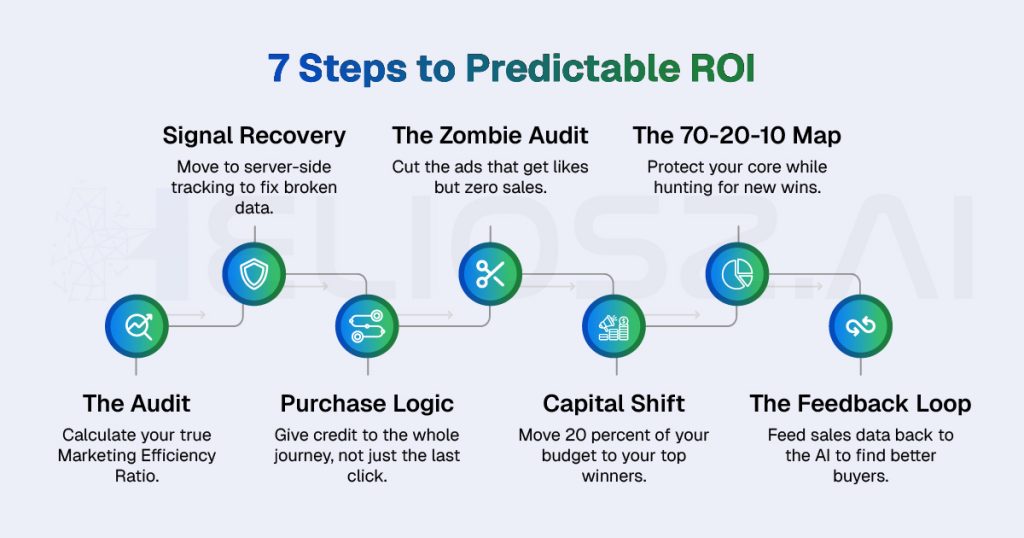
Step 1: Use MER as Your Health Check, Not Your Only Compass
Teams rely on platform-reported ROAS to guide their every move. The problem is that platforms like Meta or Google work in a vacuum; they often take full credit for a sale even if other channels helped. This creates inflated numbers and a false sense of security.
To get a real view of your business health, start with the Marketing Efficiency Ratio (MER). This looks at your total revenue against your total ad spend across all channels combined.
MER = Total Revenue ÷ Total Ad Spend
Think of MER as a top-level health metric. It tells you if your overall marketing is profitable, but it shouldn’t be your only tool for making big changes. To make the best decisions, you need to pair MER with:
- Attribution: To see which channels are actually starting or closing the deal.
- Incrementality: To prove if a specific ad spend actually drove a new sale that wouldn’t have happened otherwise.
By using MER as your foundation and then digging deeper with these tools, you can scale your budget.
QUICK READ: Revenue Forecasting in Marketing Analytics
Step 2: Fix Signal Loss with Server Side Tracking and First Party Data
You cannot optimize a budget if your data is broken. Today, privacy rules and ad blockers hide a lot of your customer actions. If you only use basic pixels, you are making decisions based on half the story.
To fix this, you need server side tracking. This sends data directly from your system to the ad platforms so you can get around browser blocks.
But server side tracking is not a perfect fix on its own. It needs your first party data, like emails or phone numbers, to work properly. This helps the platforms match a sale to the right person.
What this does for you:
- It makes your data signals much stronger
- It helps platforms find your best customers more accurately
- It fills in the gaps that standard tracking misses
Step 3: Use Better Attribution to See the Full Journey
The way you credit your sales shapes how you spend your money. Many teams still use last click attribution because it is easy. It gives all the credit to the very last thing a person clicked before buying. But this is a mistake. It makes bottom of the funnel ads look like heroes while ignoring the ads that actually introduced the customer to your brand.
To stop wasting budget, you need more reliable ways to measure what is working. In 2026, this means moving toward two specific approaches:
- Marketing Mix Modeling (MMM): This uses your historical data to show how different channels and external factors actually impact your sales. It helps you see the big picture without relying on messy tracking links.
- Incrementality Testing: This is the only way to know if a sale would have happened anyway. By running “lift tests,” you can prove if an ad actually drove a new customer or if you just paid for a sale you already had.
The goal is to stop looking at platforms individually. When you use MMM and incrementality together, you get a clear map of where your next dollar will actually drive growth.

Step 4: Identify and Eliminate Hidden Waste
Budget inefficiency usually builds up through smaller, overlooked issues across campaigns.
These often include:
- Campaigns generating engagement but not revenue
- Lead sources that produce volume but low conversion rates
- Channels that appear stable but are gradually declining in efficiency
These are often referred to as “zombie campaigns.” They consume budget without contributing meaningful results.
To address this, performance needs to be evaluated against real business outcomes, not just surface-level metrics.
Key checks include:
- Comparing cost per acquisition to actual customer lifetime value
- Tracking lead quality, not just lead volume
- Reviewing performance over complete sales cycles, not short windows
If a campaign consistently fails to meet profitability thresholds over a defined period, it should be removed. Not paused indefinitely, but actively cut to prevent further waste.
Step 5: Reallocate Budget Based on Performance
Once you find the waste, you need to move that money where it can actually grow. Performance changes every week, so you should be moving cash from your losers to your winners constantly rather than waiting for the end of the quarter.
But you have to be careful when cutting the bottom 20% of your spend. Some ads might look like they are failing because they don’t get the final click, but they might be “assisting” your sales by introducing people to your brand. If you cut them too fast, your top winners might stop performing because no one is entering the funnel anymore.
The right way to scale:
- Check for assists: Before you cut a low-performing ad, make sure it isn’t driving the awareness that leads to a sale later on.
- Test before you scale: When you move money to your winners, do it in stages so you don’t hit a wall where the ads become too expensive.
- Watch your marginal ROI: Always check if the extra dollars you added are still bringing back a profit.
Budgeting is a balance. You want to cut the true waste without accidentally killing the ads that start the customer journey.
Step 6: Balance Proven Channels with Experimentation
A common tension in marketing budgets is between stability and growth.
Focusing only on proven channels can limit future growth. At the same time, excessive experimentation can create volatility and reduce short-term performance.
A structured allocation model helps manage this balance.
The 70-20-10 approach is widely used for this reason:
- 70% of the budget goes to proven, consistently performing channels
- 20% is allocated to expanding existing strategies (new audiences, formats, or geographies)
- 10% is reserved for testing entirely new ideas
This model ensures that the majority of spend remains stable while still allowing room for learning and growth.
It also reduces risk. If experimental campaigns fail, the impact on overall performance remains limited.
Step 7: Build a Feedback Loop with Real Revenue Data
Ad platforms optimize based on the signals they receive. If those signals are limited to clicks or basic conversions, optimization will remain shallow.
To improve performance, platforms need access to deeper, outcome-based data.
This means feeding actual revenue events back into the system.
For example:
- When a lead converts into a paying customer
- When a deal is closed
- When a repeat purchase is made
By sending this data back through APIs or integrated systems, you help platforms identify patterns associated with high-value customers.
Over time, this leads to:
- Better audience targeting
- More efficient bidding strategies
- Higher-quality conversions
Without this feedback loop, campaigns often optimize for volume rather than value.
Your Marketing Budget Optimization Checklist
| Frequency | What to Do | Why It Matters |
| Weekly | Refresh creatives and adjust bids | Keeps performance stable and prevents rising costs |
| Monthly | Review channel performance | Helps shift budget from weak areas to strong ones |
| Quarterly | Run incrementality tests | Validates if campaigns are driving real growth |
| Annually | Review strategy and tech stack | Ensures your setup still supports business goals |
3 Takeaways to Transform Your Marketing Spend Optimization
- Start with real performance, not reported metrics: Use business-level data to guide decisions. Platform numbers can mislead, but revenue and efficiency ratios show what is actually working.
- Test early to reduce waste: Run controlled tests before scaling campaigns. This helps identify what works and prevents budget from being spent on ideas that won’t deliver.
- Track the full funnel, not just conversions: Look beyond top-line results. Monitor how leads move through the funnel and whether they turn into revenue. This keeps your spend tied to actual business impact.
Closing Thoughts
The era of easy, low-cost growth is fading. Budgets are under more scrutiny, and the margin for error is smaller than it used to be.
What separates high-performing teams today is not how much they spend, but how well they allocate. Relying on inflated dashboards and incomplete tracking creates a false sense of control, and over time, that gap shows up in missed targets and shrinking returns.
The shift is already happening. Teams that treat budget optimization as a structured, ongoing system are pulling ahead. They are not waiting for perfect data. They are working with what they have, correcting for gaps, and making sharper decisions over time.
This is not about reacting to performance. It is about taking control of it.
Because in the end, growth is not driven by spend alone. It is driven by how deliberately that spend is managed.
FAQ’s
What is marketing budget optimization?
It is simply moving your money from what fails to what wins. Instead of just buying clicks, you are focusing your spend on the specific ads that turn into actual cash in the bank.
What framework should leaders use to allocate budget for maximum ROI?
The 70/20/10 rule is the gold standard. Put 70 percent into your safe winners, 20 percent into growing new leads, and 10 percent into wild experiments. This keeps your revenue steady while you hunt for the next big win.
What is the biggest cause of wasted marketing spend?
It is usually a mix of things. While bad data is a huge problem because it makes you pay for the same sale twice, it isn’t the only cause. You also lose money when your ad creatives get boring, when you target the wrong audience, or when you keep spending on a channel that is already saturated. To stop the leak, you have to fix your data and keep your ads fresh at the same time.
How do you optimize a marketing budget across channels?
Stop looking at apps individually. Look at the whole journey. Once you see which channels start the conversation and which ones close the deal, you can move cash from the losers to the winners every month.
What is a good marketing budget as a percentage of revenue?
Most healthy companies spend between 5 percent and 10 percent of their revenue on marketing. The real goal is your efficiency ratio. As long as your spend brings back a solid profit, you are in the right range.
What metrics matter most for effective Marketing Budget Optimization?
The most important metrics for Marketing Budget Optimization include the LTV-to-CAC ratio, payback period, incremental revenue by channel, contribution margin, and retention rates. These metrics move beyond last-click attribution and help brands understand which investments create sustainable, long-term value rather than short-term performance spikes.