


 5 Min Read
Leadership expects profitable growth, yet teams struggle to connect the dots across pricing, assortment, trade terms, and consumer demand.
What if you could eliminate the guesswork?
A connected commercial intelligence platform brings everything together: harmonized retailer data, real-time trade promotion intelligence, AI-powered demand sensing, and actionable commercial analytics, into one unified view.
In this guide, we’ll explore what commercial intelligence truly means, why it matters now more than ever, must-have features, top use cases, and a practical framework to implement the right solution for sustainable revenue growth.
What Does Commercial Intelligence Mean? (What is a Connected Commercial Intelligence Platform?)
Commercial intelligence is the systematic process of collecting, harmonizing, analyzing, and activating internal and external data to drive informed, revenue-focused commercial decisions.
Unlike traditional business intelligence that focuses mainly on internal operations, commercial intelligence targets the specific levers that impact revenue and profit.
A Connected Commercial Intelligence Platform goes one step further. It acts as a unified data platform that:
-
 Ingests data from multiple sources including POS, retailer portals, syndicated data, ERP systems, and consumer signals
 -
Performs retailer data harmonization to eliminate silos
-
Applies AI-powered commercial intelligence and advanced analytics
-
Delivers real-time, actionable insights
In the FMCG and CPG sector, this platform directly powers revenue growth management (RGM). It connects demand sensing with trade promotion intelligence, enabling precise forecasting, optimized trade spend, better assortment decisions, and a truly data-driven commercial strategy.
In simple terms, it turns fragmented information into a single source of commercial truth, helping teams shift from reactive reporting to proactive, profitable decision-making.
Why is Commercial Intelligence More Important Than Ever for FMCG/CPG?
The FMCG and CPG industry has always run on data, but today’s market conditions have made a connected commercial intelligence platform essential rather than optional.
Three major forces are compressing decision windows:
-
CPG manufacturers typically integrate data from dozens of retailers with varying formats. According to PYMNTS Intelligence and similar 2025 retail data studies, a large majority of companies (around 60%+) cite siloed data as a major barrier to real-time demand response. This lack of retailer data harmonization leads to blind spots in commercial planning.
-
Massive Trade Spend with Low Visibility:
Trade promotions represent 15-20% of gross revenue for most CPG companies (a widely referenced industry benchmark from McKinsey and trade reports). Despite this, many promotions deliver poor ROI due to limited real-time trade promotion intelligence and ineffective revenue growth management (RGM).
-
Accelerating Need for Speed:
Consumer expectations for relevant offers are high, with studies showing nearly 70% of shoppers more likely to buy when promotions adjust in real time. Combined with rising private label competition and demand volatility, slow insights result in lost share. Companies using unified platforms achieve substantially faster decisions and better commercial outcomes.
A modern Connected Commercial Intelligence Platform powered by AI closes these gaps, turning fragmented data into a competitive advantage.
Top Use Cases for Commercial Intelligence in FMCG/CPG
Here are the most impactful, real-world use cases where connected commercial intelligence platforms and AI-powered commercial intelligence deliver proven results in the FMCG/CPG sector:
-
Trade Promotion Optimization & ROI Improvement One of the highest-value applications. Platforms analyze historical promotion data, simulate scenarios, and optimize timing, depth, and mechanics of promotions. Leading CPG companies use this to move beyond the industry average where ~70% of promotions fail to deliver profit, achieving measurable lifts in incremental volume and ROI.
-
Revenue Growth Management (RGM) Across Key Levers Holistic optimization of pricing, pack-price architecture, assortment, trade terms, and channel mix. Mature RGM implementations help companies deliver 3–5% gross profit improvement annually through better commercial decisions.
-
Advanced Demand Sensing and Forecasting AI models detect early demand signals from POS, weather, social, and consumer data to improve forecast accuracy. This reduces stockouts and overstock while enabling faster response to shifts in consumer behavior.
-
Post-Promotion Analysis and Insights Automated attribution of sales lift, cannibalization effects, and true incremental ROI. Teams gain granular understanding of what worked (and what didn’t) across retailers, categories, and regions.
-
Portfolio and Assortment Optimization Identifying underperforming SKUs, white spaces, and ideal product mix per retailer/channel. This helps maximize shelf space efficiency and profitability.
-
Retailer Negotiation and Joint Business Planning Providing data-backed insights during negotiations such as category contribution, promotion effectiveness, and recommended trade terms, leading to stronger partnerships and mutually beneficial agreements.
Companies like Reckitt (using AI-enabled RGM) have reported over $100 million in additional revenue, while others see consistent gains in promotional ROI and overall commercial performance.
A Four-Step Framework for Choosing and Implementing Your Connected Commercial Intelligence Platform
Implementing a connected commercial intelligence platform is a major strategic move for FMCG and CPG companies. It directly affects revenue growth management, trade promotion effectiveness, and overall commercial performance. Here is a practical, four-step framework to guide the process:
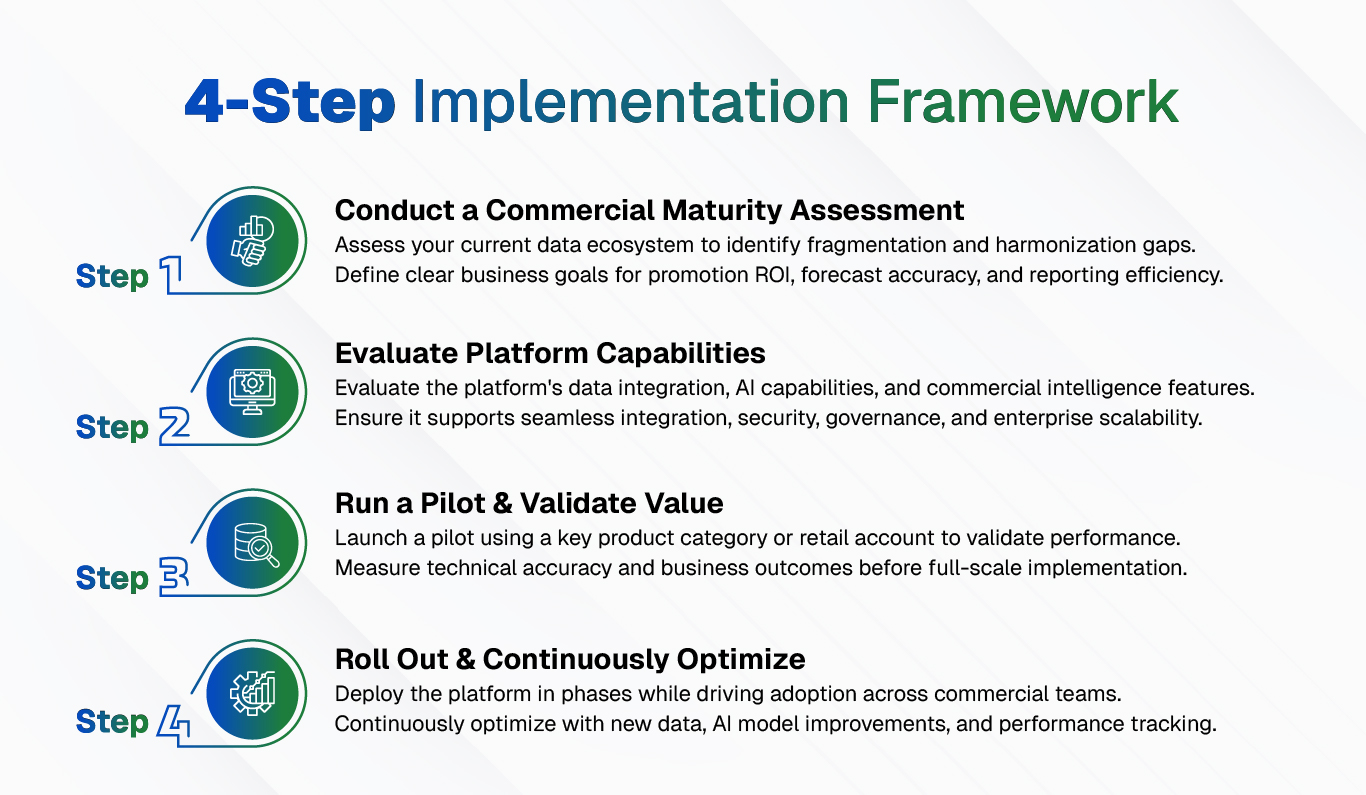
Step 1: Conduct a Commercial Maturity Assessment
Start by mapping your current data ecosystem: including POS systems, syndicated data, retailer portals, ERP, and trade promotion tools. Identify where data is fragmented and where retailer data harmonization is weakest. Assess gaps in demand forecasting accuracy, promotion ROI visibility, and overall revenue growth management capabilities.
Define clear success metrics upfront, such as 15-20% improvement in promotion ROI, 10-15% better forecast accuracy, or significant reduction in manual reporting time. This step ensures you focus on the areas that will deliver the biggest impact.
Step 2: Technical and Functional Evaluation
Score potential vendors based on the following key capabilities:
-
Strength of the unified data platform and automated data harmonization
-
Quality of AI and machine learning models for demand sensing, price elasticity, and promotion optimization
-
Support for core revenue growth management levers (pricing, assortment, and trade terms)
-
Integration ease with your existing systems (SAP, Oracle, retailer APIs, etc.)
-
Security, governance, and ability to handle large-scale CPG data volumes
Give preference to platforms that have strong, proven case studies in the CPG industry with measurable business results.
Step 3: Structured Pilot and Value Validation
Choose a high-visibility pilot, such as one major product category or key retail account. Load historical and live data, set up harmonization rules, and run parallel tests on demand sensing, promotion planning, and scenario modeling.
Measure both technical performance (data processing speed, model accuracy) and business outcomes (projected ROI improvement). This phase also helps you understand the real total cost of ownership and integration effort before full commitment.
Step 4: Enterprise Rollout, Adoption, and Continuous Optimization
Roll out the platform in phases, with strong change management support for commercial and sales teams. Build an internal Center of Excellence for revenue growth management and analytics.
Set up ongoing model retraining, add new data sources as needed, and expand into advanced features like prescriptive recommendations. Continuously track performance against your original goals and adjust as market conditions change.
This four-step framework helps CPG companies move from fragmented data and reactive decisions to a more connected, intelligent approach that supports sustainable and profitable growth.
Who Uses Connected Commercial Intelligence Platforms?
Connected commercial intelligence platforms are built for cross-functional teams that need a complete view of commercial performance. Instead of working with disconnected reports across departments, they give every team access to the same trusted data, making collaboration and decision-making much easier.
CPG & FMCG
CPG and FMCG brands use connected commercial intelligence to understand what drives growth. Teams can measure promotion performance, monitor pricing, identify distribution gaps, optimize trade spend, and track SKU performance across different markets and retail channels. With all commercial data in one place, they can make faster and more confident decisions.
Retail
Retail teams rely on these platforms to connect data from physical stores, e-commerce channels, and marketplaces. This helps them monitor category performance, optimize assortments, manage inventory more effectively, and understand customer buying patterns. A unified view makes it easier to improve both operational efficiency and the overall customer experience.
Fashion & Apparel
Fashion and apparel brands use connected commercial intelligence to track product performance, understand changing consumer demand, optimize pricing and promotions, and manage seasonal inventory. By combining sales, merchandising, and customer data, they can respond faster to trends and make smarter merchandising decisions.
Sports
Sports brands and retailers use these platforms to monitor product demand, evaluate campaign performance, optimize inventory across channels, and identify emerging consumer preferences. Bringing together sales, marketing, and distribution data helps them improve product availability, increase profitability, and deliver better customer experiences.
The Heliosz.AI Advantage
Heliosz.AI combines a client-owned intelligence platform with expert hands-on services to help your data drive real commercial outcomes.
Optivo is our flagship Unified Commercial Intelligence Platform built for FMCG, CPG, and enterprise teams. It brings your marketing, pricing, promotions, product, distribution, and operations data into one place, so you can stop jumping between disconnected tools and start making decisions with confidence.
-
See which marketing and commercial investments are actually delivering results
-
Understand how pricing, promotions, and trade spend impact your margins and revenue
-
Identify your best-performing SKUs, distribution gaps, and assortment opportunities
-
Monitor digital shelf performance and understand online shopper behavior
-
Improve demand forecasting by connecting demand signals with supply chain planning
With Optivos, you can:
The biggest advantage is having everything in one place. Instead of spending hours pulling reports from different systems or trying to reconcile conflicting dashboards, every team works from the same trusted data. That means faster decisions, better collaboration, and more time spent acting on insights instead of searching for them.
Optivos is flexible too. You can use it as a SaaS platform or deploy it within your own environment, while keeping full control of your data.
Closing Thoughts
The truth is simple: in today’s FMCG and CPG world, data is everywhere, but real commercial clarity is rare.
The brands that pull ahead aren’t necessarily the ones with the biggest budgets. They’re the ones who finally connect the dots, turning scattered retailer reports, promotion results, and demand signals into one clear, intelligent picture that every team can act on.
A truly Connected Commercial Intelligence Platform changes how decisions get made. It doesn’t just show you what happened yesterday. It helps you see what’s coming next, where the real opportunities are, and how to protect your margins while growing share.
This is no longer a nice-to-have. It’s the new baseline for competing profitably.
At Heliosz, we’ve built our platform for ambitious commercial leaders who are tired of guessing and ready to lead with confidence. If you’re serious about elevating your revenue growth management, sharpening trade execution, and building a genuinely data-driven organization, we’d love to show you what’s possible.