
 5 Min Read
As a CMO, you carry immense responsibility. Every decision you make and every forecast you present shapes your company’s future. Your executive team and your department depend on your marketing forecasts to decide where to invest and how to grow.
Think of a marketing forecast as your team’s North Star. It provides direction, helps set realistic goals, and shows whether you’re truly on track. When your direction is clear, your projections gain both accuracy and credibility.
In this guide, we’ll show you how to move well beyond basic predictions. You’ll discover how to build sharper, more reliable projections using advanced enterprise marketing forecast tools.
Let’s explore the approaches that help you earn trust and deliver stronger results for your brand.
What Is Marketing Forecasting, and Why Does It Matter?
Marketing forecasting is like a weather report for your business , but far more strategic. It involves a thorough analysis of your historical data, market trends, and external signals to anticipate what lies ahead. By combining market research with your own performance history, you can project future customer demand, website traffic, and revenue with greater confidence.
These forecasts matter because they give leadership a clearer picture of upcoming risks and opportunities. They transform guesswork into informed decision-making.
For marketing teams, strong revenue forecasting delivers several critical advantages:
- Spot Issues Early: You can identify potential problems before they derail your plans.
- Allocate Budget More Effectively: It sharpens marketing ROI by helping you invest where returns are highest and avoid wasteful spending.
- Plan for Sustainable Growth: You gain visibility into where the market is heading, allowing you to position your brand ahead of the curve.
- Stay Accountable: Regular comparison between actual results and forecasts reveals whether your strategy is working or needs adjustment.
Getting Your Data Ready for Accurate Forecasting
Before you can trust any predictive marketing tool, you must first ensure your foundation is solid. Think of your data as the ingredients of a fine meal, poor ingredients will always produce disappointing results, no matter how advanced the recipe.
To achieve strong marketing forecast accuracy and move beyond basic predictions, focus on collecting and organizing these essential types of information:
- Funnel Metrics: Track the complete customer journey, from the first website visit and initial engagement all the way through lead conversion and final purchase. Every stage matters.
- Clearly Defined Objectives: A forecast without clear goals is aimless. Anchor your projections to the specific outcomes your team and leadership want to achieve this year.
- External Market Signals: Markets never stand still. Incorporate factors such as seasonality, economic shifts, industry trends, and changes in consumer behavior that can significantly influence spending patterns.
By blending clean internal data with relevant external signals, you build a robust foundation for revenue forecasting. This comprehensive view enables sharper insights and more confident decisions that actually drive brand growth.
The 9-Step Framework for Accurate Marketing Forecasts
Building an accurate forecast is about following a reliable process. For enterprise leaders, this framework ensures your predictions are grounded in reality so you can make confident marketing investment decisions.
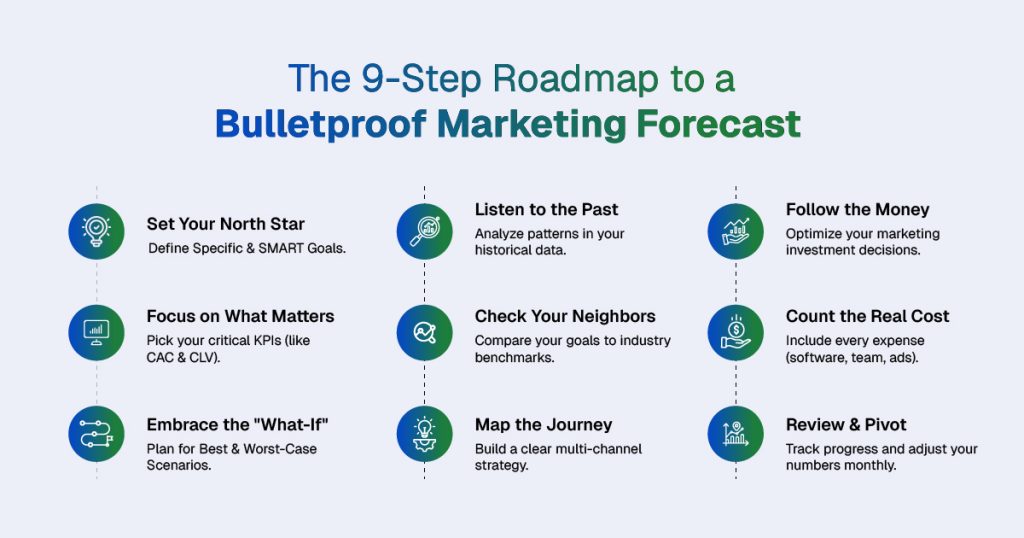
1. Define Your SMART Goals
Every great plan starts with knowing exactly where you are going. Use the SMART method: Specific, Measurable, Achievable, Relevant, and Time-bound. Instead of saying “we want more leads,” say “we want to increase MQLs by 15% by the end of Q3.” Clear goals give your marketing forecast tools a target to aim for.
2. Choose the Metrics that Actually Drive Growth
At the enterprise level, basic CAC isn’t enough. To truly lead, you need to look at the “Efficiency Frontier” using these advanced metrics:
- Marginal ROI: What is the return on the next dollar spent?
- Incremental CAC: How much does it cost to acquire a customer that wouldn’t have converted anyway?
- Channel Saturation Curves: At what point does adding more budget to a channel stop producing results?
- Incremental Revenue: Measuring the revenue that is strictly “extra” because of a specific campaign effort.
3. Use Scenario-Based Marketing Forecasting
The world is unpredictable, so your plan should be too. Create “What-If” scenarios for best-case and worst-case outcomes. For example, what happens if a major competitor drops their prices, or what if your social media ads perform twice as well as expected? Scenario-based marketing forecasting helps you stay ready for anything.
4. Leverage Your Historical Data
Your past is a great teacher. Look at your performance from previous years to find patterns. While the market changes, seeing how your brand handled growth or slumps in the past helps you build a more realistic marketing performance forecasting model.
5. Look at Industry Benchmarks
Don’t just look inside your own company; look outside at your neighbors. By checking how other companies in your niche are doing, you can see if your expectations are realistic. Industry data helps you understand if a dip in sales is just a market trend or something specific to your brand.
6. Create a Detailed Marketing Plan
Now, map out your journey. Your plan should list every channel like email, search ads, and social media, and explain how they will work together. When you have a clear map, it is much easier to see where your multi-channel forecast modeling might need an adjustment.
7. Allocate Your Budget Wisely
This is where the math meets the mission. Based on your forecast, decide where your money will do the most work. Marketing budget scenario planning ensures that your highest-performing channels get the resources they need to succeed.
8. Factor in All Your Expenses
A forecast can fail if you forget the hidden costs. Make sure you include:
- Software and platform fees.
- Payments for contractors or agencies.
- Internal team salaries and overhead.
9. Track, Adjust, and Repeat
A forecast is not a “set it and forget it” document. You should check your progress every week or month. If the real world looks different than your prediction, don’t be afraid to reset your numbers. Constant tracking is the secret to marketing forecast accuracy.
Modern Marketing Forecasting Methods & Techniques
The era of relying on gut feelings and basic spreadsheets is over. Today’s enterprise leaders are shifting toward advanced and intelligent techniques that provide deeper visibility and greater foresight. Success now depends on using smarter methods to uncover meaningful patterns and connections.
Here are the most effective modern marketing forecasting methods that leading CMOs and enterprise teams are adopting:
1. Correlational Analysis: Uncovering Hidden Relationships
At the enterprise level, simply observing two numbers is not enough. Correlational analysis is a statistical technique that measures the strength and direction of relationships between different variables.
For example, you might observe that a $50k bump in YouTube brand awareness correlates with a 12% spike in organic search exactly eight days later. This correlation suggests a strong relationship, allowing you to model how video spend likely supports search performance, even if the paths aren’t direct.
By quantifying this relationship, you can accurately predict how changes in video advertising spend will impact search performance.
This method helps break down channel silos and reveals how different marketing activities influence and support one another across the customer journey.
2. Predictive Marketing Tools Powered by AI and Machine Learning
Modern forecasting has entered the age of AI. Advanced predictive marketing platforms go far beyond simple calculations. They use machine learning models and neural networks that continuously learn and improve over time.
These systems analyze vast amounts of data including historical sales, website behavior, economic indicators, seasonality, and even external factors such as weather or industry trends.
While AI models don’t suffer from ‘fatigue’ like a human analyst, they are not immune to bias. An AI is only as neutral as the data it is fed. In an enterprise setting, your team must audit these models to ensure that historical data gaps or flawed assumptions aren’t being baked into your future projections.
3. Collaborative Insights: Bridging the Sales-Marketing Gap
The strongest forecasts combine hard data with human context. Collaborative forecasting brings Sales and Marketing teams together to share insights that no algorithm can fully capture on its own.
- Customer Feedback Analysis:
Tools that process customer reviews, support tickets, and survey responses help surface emerging needs and sentiment shifts before they appear in sales numbers.
- Sales Team Input:
Sales professionals interact with prospects and customers daily. Their observations such as growing price sensitivity or changing buyer priorities provide critical early signals that can be factored into forecasts.
When you combine the precision of AI-driven analysis with real-time human insights, your forecasting becomes far more robust and actionable. You move from simply predicting outcomes to building strategies rooted in the true pulse of your market.
Enterprise-Grade Governance and Security
Your forecast is only as good as your compliance. In 2026, enterprise procurement and legal teams won’t approve a forecasting tool that doesn’t prioritize Data Governance.
A robust SSoT framework must include:
- Privacy-First Architecture: Built-in compliance for GDPR, CCPA, and DMA to ensure user data is handled legally.
- PII Controls: Automated redaction of sensitive customer details before they enter the modeling layer.
- Access Governance: Strict protocols on who can touch the data, ensuring your “Source of Truth” remains secure and audit-ready.
Closing Thoughts
Mastering marketing forecasting is what separates guessing your budget from truly owning your growth. When you move past clunky spreadsheets and start using proper enterprise marketing prediction tools, you don’t just get better numbers, you get the confidence to lead your market instead of chasing it.
The real secret to accurate forecasts isn’t being right 100% of the time. It’s building a repeatable process that transforms “What if?” into “What’s next?” The more you trust your data and keep refining your approach, the more uncertainty stops feeling like a threat and starts becoming your biggest competitive advantage.
Ready to get started? Open up your historical data, take an honest look at it, and pick one clear SMART goal for the next quarter. Your numbers are already telling a story of growth, now it’s time to give them the right tools to speak louder. Contact us!