Email:
inquiry@heliosz.ai
Email:
inquiry@heliosz.ai Phone: +1 (332) 255-6223



 5 Min Read
For years, CPG brands fought for space on the physical shelf. Then came the digital shelf: product pages, search rankings, and retail media. Both still matter. But a quieter shift is underway.
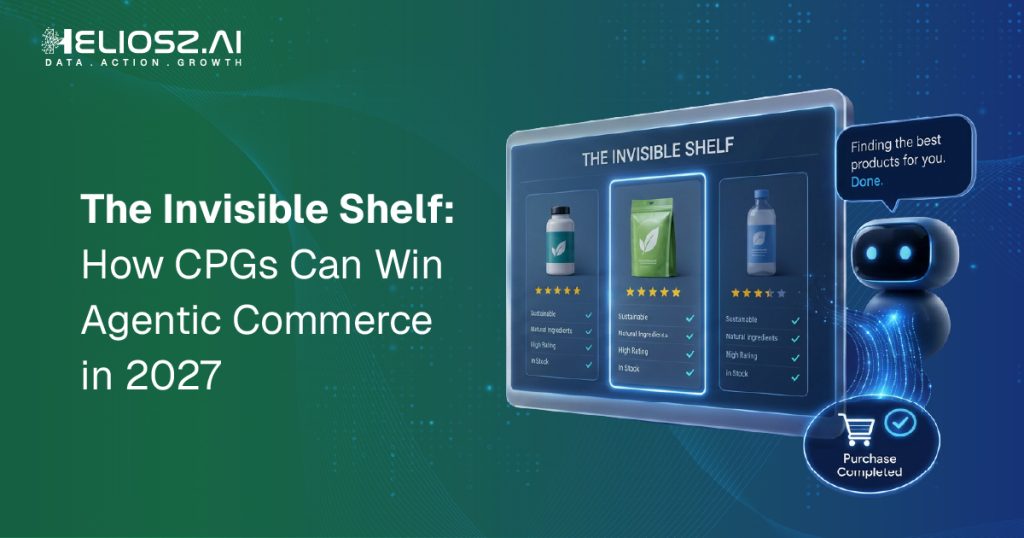
Shoppers are starting to hand more of their decisions to AI agents. These agents do not browse the way people do. They move through data, comparing options and making choices without ever looking at packaging or scrolling a product page.
The brands that remain visible will be the ones whose information is clear and connected. The ones that are not risk fading from consideration, even when their products are strong.
Winning in this new environment requires a different kind of foundation: commercial intelligence that keeps products visible to the systems now influencing more purchase decisions.
Key Takeaways
- AI agents are creating a new invisible shelf where product discovery and purchase decisions increasingly happen without human browsing.
- Brands that keep commercial data scattered across systems risk becoming invisible, even if their packaging, distribution, and marketing remain strong.
- Winning requires connected commercial intelligence that makes products clear, comparable, and prioritizable to the systems influencing more buying decisions.
READ MORE: How AI Will Disrupt Brand Building
Understanding the Invisible Shelf
Brand equity, physical availability, and packaging still matter. A strong brand, reliable distribution, and distinctive packaging continue to influence both shoppers and retailers. At the same time, a new layer of decision-making is forming.
Shoppers are beginning to rely on AI agents that can discover products, compare options, negotiate, and complete purchases on their behalf. These agents work quietly in the background, evaluating information far faster than any human could.
Two primary interaction models are emerging:
- Consumer-agent interactions: A shopper’s personal AI agent can search across retailers, compare products, check availability, and complete a purchase based on the shopper’s preferences and requirements.
- Agent-to-agent interactions: A retailer or merchant agent can interact with other systems or agents to locate inventory, source products, or prevent a sale from being lost when an item is unavailable.
In both models, agents become collaborators. The brands that capture more revenue are the ones whose data is ready to be read and acted upon.
Stocking the Invisible Shelf
Attractive packaging still wins attention in stores. On the invisible shelf, structured and governed commercial data does the same job for AI agents. If product attributes, claims, certifications, or performance signals are incomplete or disconnected, agents cannot reliably surface the brand.
Here is how CPG teams can prepare:
Treat commercial data as the new packaging
AI agents evaluate products through machine-readable attributes rather than marketing language. Clean, standardized data on ingredients, certifications, nutritional information, allergens, and product specifications becomes essential. Without this foundation, even strong products risk being overlooked.
Master digital shelf and commerce signals
Agents also weigh real digital shelf performance. Search presence, content quality, ratings, reviews, and retail media results all influence whether a product is considered or passed over. Brands that actively track and improve these signals give agents clearer reasons to include them.
Connect the full commercial picture
Marketing effectiveness, pricing and promotion impact, revenue attribution, and demand forecasting often live in separate systems. When these signals remain siloed, teams lack a complete view of what drives performance. Bringing them into one connected view allows faster, more confident decisions.
Prepare for faster commercial responses
As agent-to-agent interactions increase, brands need the ability to respond quickly to inventory, pricing, and promotional signals. A unified commercial intelligence layer provides the practical foundation for that speed, reducing delays caused by fragmented reporting and manual consolidation.
Together, these steps help ensure products remain visible, comparable, and prioritizable when AI agents make more of the discovery and purchase decisions.
ALSO READ: How to Use Predictive Analytics to Plan Marketing Campaigns
The Business Impact
The brands that treat commercial data as a strategic asset are already seeing clearer outcomes.
When an AI agent is asked for a product that meets specific needs such as verified sustainable packaging, suitable for sensitive skin, or high-protein and available for same-day delivery, only products with clean, complete, and consistent attributes tend to appear. Brands that have structured their data properly gain visibility in these high-intent moments. Brands that have not simply drop out of consideration, even if their physical distribution and packaging remain strong.
On the commercial side, teams gain tighter control. Pricing and promotion decisions rest on shared signals rather than conflicting reports, which reduces leakage and improves the return on trade spend. Demand signals become clearer earlier, so inventory and supply responses can keep pace when agent-driven volume spikes.
The net effect is practical: higher inclusion in agent recommendations, better protection of margins, and the ability to capture volume that would otherwise shift to more data-ready competitors.
Winning Across All Shelves
Physical packaging, brand equity, and distribution still matter. Digital shelf performance still matters. What is changing is the need to make those strengths readable to the systems now influencing more purchase decisions.
By combining traditional strengths with agent-ready commercial intelligence, CPG leaders can:
- Increase visibility:Clean product data and strong digital shelf signals help surface brands when AI agents respond to high-intent requests.
- Protect margins: Connected views of pricing, promotions, and revenue reduce leakage and improve the quality of commercial decisions.
- Grow volume: Unified data and clearer demand signals help products appear across physical, digital, and invisible shelves, including moments where agents source or recommend on a shopper’s behalf.
The brands that move first will not only protect their existing position. They will be better prepared for a market where more discovery and purchase decisions happen quietly, through data rather than through traditional browsing.
Closing Thoughts
The shift is already underway. More shopping decisions are beginning to move through systems that evaluate products quietly, without the traditional signals of packaging, placement, or page design.
The brands that adapt will treat commercial data with the same seriousness they once reserved for physical shelf space. Those that do not may continue to perform well in familiar channels while slowly losing ground in the moments that matter most.
Preparation starts with clarity. The clearer and more connected a brand’s commercial information becomes, the more ready it will be when agents start making a larger share of the choices.
The invisible shelf is forming whether brands are ready or not. The only real question is who will still be visible when it does.