

 5 Min Read
Marketing intelligence platforms are only as smart as the language we give them. Companies have built systems that can predict, optimize, and personalize at scale, then fed those systems fragmented and inconsistent data. The result is sophisticated tools producing half-truths, and revenue leaders making expensive decisions on unreliable foundations.
A data taxonomy is what corrects this. In 2026 it has become the difference between marketing technology that produces clarity and marketing technology that produces costly confusion.
This guide explains what a marketing data taxonomy is, why artificial intelligence makes it more important rather than less, what a strong one looks like, and how to build one without overcomplicating the process.
What Is a Data Taxonomy in Marketing?
A data taxonomy in marketing is a standardized, hierarchical system for naming, categorizing, and connecting every campaign, channel, audience, and outcome across your commercial data. It defines the official language that your organization and your platforms use to describe the business, so the same activity carries the same meaning in every system.
Naming conventions and tags are only the visible surface. Underneath them, a taxonomy defines how scattered data points connect into a coherent whole that platforms can accurately interpret.
Companies often treat this work as a technical cleanup task. The stronger approach is to treat it as a strategic capability that decides whether the entire martech investment delivers clarity or simply adds more data.
The Real Problem: Every Team Speaks a Different Language
The issue is rarely duplicate records or poor data quality in the abstract. The deeper problem is inconsistent business language across functions.
Consider one commercial activity seen through four departments:
| Team | What they call it |
| Marketing | “Campaign” |
| Sales | “Deal Acceleration Program” |
| Retail Operations | “Trade Promotion” |
| Finance | “Marketing Investment” |
The same reality now lives in four systems with four meanings. Your platforms treat them as four unrelated entities. Reports fragment, attribution breaks, and executive dashboards show conflicting pictures of the exact same performance.
That is a business-definition problem, and no platform, however advanced, can create truth from misaligned definitions. A platform can only aggregate what it is given. When teams use different words for the same thing, the system returns noise instead of intelligence.
A well-designed taxonomy resolves this by mapping every team’s language back to one canonical entity:
| What each team calls it | Canonical entity | Definition of record |
| Campaign, Deal Acceleration Program, Trade Promotion, Marketing Investment | commercial_activity | Any funded initiative that drives demand, tagged to one budget line and one outcome metric |
In a single row, four teams are reconciled, and every platform can now reason about the same underlying reality.
What Good Taxonomy Looks Like: Naming Conventions
Alignment shows up first in something as ordinary as how you name a campaign. Organizations often accumulate hundreds of versions of the same idea:
- FB_Ad_Summer
- Facebook-Summer-Promo
- fb_summersale_2026_v2
To a person, these are obviously the same thing. To your analytics platform, they are three unrelated line items, which means your channel reporting is quietly wrong.
A taxonomy replaces that chaos with a single structured format:
Channel-Type-Platform-Objective-Campaign-Year
→ Social-Paid-Facebook-BrandAwareness-SummerSale-2026
Every field is a controlled value pulled from an agreed list. The question “how did paid social perform this summer?” now has one clean answer instead of three approximations. Multiply that consistency across every channel, segment, and KPI, and you build data that leaders can trust.
Taxonomy Is Business Architecture, Not Data Management
Discussions of taxonomy often stay shallow, focused on naming and tagging, which misses the larger point. A strong data taxonomy is business architecture translated into data structures. It is the official model through which your organization understands its commercial world, with consistent definitions and hierarchies for:
- Products and product catalogs
- Customer segments and account structures
- Channels and engagement touchpoints
- Promotions, offers, and campaigns
- Geographic territories and sales hierarchies
- Brand and category frameworks
- KPI definitions and measurement logic
While taxonomy provides the classification framework for organizing commercial data, it works alongside the semantic layer, which defines business meaning; the data model, which defines relationships between data; and master data management (MDM), which governs core business entities.
Why AI Makes Taxonomy More Important, Not Less
Leaders frequently assume that AI will clean up messy data on its own, but the opposite is true. AI can help improve data quality, but it cannot compensate for paoorly designed business definitions, inconsistent taxonomy, or unclear data structures.
When taxonomy is weak, the failure compounds in a predictable sequence:
- Inconsistent taxonomy creates poor training data.
- Poor training data produces unreliable AI recommendations.
- Unreliable recommendations drive flawed executive decisions, faster and at greater scale.
This weakness reaches every modern AI application directly. Large language models interpret business context from how data is structured and labeled. Forecasting models assume consistent definitions across datasets. Recommendation engines and commercial copilots depend on clean hierarchies to produce accurate answers. When you feed them fragmented language, they do not generate intelligence, they generate confident and incorrect answers at machine speed.
AI therefore does not remove the need for standardization, it raises the stakes on getting it right. Organizations with mature taxonomy watch their AI initiatives compound, while those that skip it watch AI multiply the problems they already had.
How to Build a Marketing Data Taxonomy
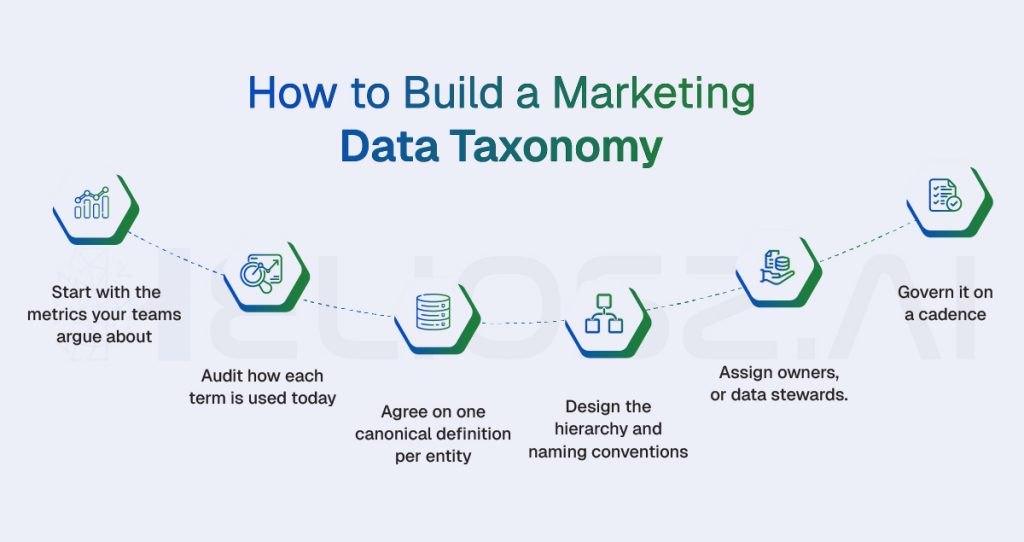
You do not build a taxonomy by writing one enormous document. You build it as an ongoing capability, and a practical sequence looks like this.
1. Start with the metrics your teams argue about. Pick the five numbers that people fight over in every quarterly review, such as pipeline source, campaign ROI, qualified lead, active customer, and attributed revenue. Those become your first five definitions, rather than the entire catalog.
2. Audit how each term is used today. Document every system, label, and definition currently in play for those terms. This is where the real disagreements surface, which is exactly the point.
3. Agree on one canonical definition per entity. Force a single definition of record, then map every team’s existing language to it. Consensus here matters more than perfection.
4. Design the hierarchy and naming conventions. Structure your categories, sub-categories, and controlled value lists. Keep names simple, human-readable, and consistent.
5. Assign owners, or data stewards. Every major domain, from products to segments to channels to KPIs, needs a named person accountable for its definitions. Taxonomy without ownership decays within a quarter.
6. Govern it on a cadence. Establish a regular review that approves changes to definitions and hierarchies. Treat it as an evolving system that changes with the business, rather than a static document.
Support that governance with version control, approval workflows, change management, and an audit trail. These practices ensure every change is documented, approved, and communicated before it affects reports, dashboards, or AI models.
At the same time, remember that clean data is not just error-free data. It should be complete, accurate, consistent, timely, unique, and valid. Taxonomy gives that data a common structure so every team interprets it the same way.
When Not to Over-Engineer Your Taxonomy
A word of caution, because the failure mode is real. Teams that discover taxonomy sometimes try to model everything at once, spend six months in workshops, and ship a polished framework that nobody adopts.
That path should be avoided, because a taxonomy is only as valuable as the decisions it improves. If a distinction does not change a report, a budget, or a recommendation, it probably does not need its own category yet. Begin with the entities that drive real decisions, prove the value, and expand from there. A working taxonomy that covers your top 20 terms is worth more than a perfect one that never launches.
The Silent Language of Competitive Advantage
The companies that win the next decade will not be the ones holding the largest volume of data or the flashiest AI. They will be the ones that master the shared definitions beneath it all.
Data taxonomy will never appear on an earnings call or trend on LinkedIn. Yet it quietly determines whether your organization sees performance clearly or works from conflicting definitions. It separates decisions made with confidence from decisions made with hope.
The real question is no longer whether you need it. The real question is how long you can afford to keep operating without it.
FAQ
What is a data taxonomy in marketing?
It is a standardized, hierarchical system for naming, categorizing, and connecting marketing data such as campaigns, channels, audiences, and outcomes, so the same activity carries the same meaning across every team and platform.
What is the difference between a taxonomy and an ontology?
A taxonomy classifies data into structured categories and hierarchies. An ontology goes further and defines the relationships between those entities. Marketing teams generally need a solid taxonomy first, with ontology as a later and more advanced layer.
Why is data taxonomy important for AI in marketing?
AI models learn from how data is structured and labeled. Inconsistent taxonomy produces poor training data, which produces unreliable recommendations. A strong taxonomy is what allows AI to generate trustworthy insight instead of fast and confident errors.
Who should own the marketing data taxonomy?
It is a cross-functional discipline rather than an IT project. Assign named data stewards for major domains such as products, segments, channels, and KPIs, with active ownership from marketing, sales, RevOps, finance, and product.
How do I start building a data taxonomy?
Begin with the five metrics that your teams disagree on, audit how each is currently defined, agree on one canonical definition per entity, design naming conventions, assign owners, and review on a regular cadence. Start small and expand.