 5 Min Read
You have access to more marketing data than ever before, but turning it into clear decisions is still difficult.
Many teams collect reports from different platforms, yet they still feel unsure about what is really working and where they should spend their budget next.
Marketing intelligence platform helps fix this.
It means gathering and studying information from both inside your company and from the wider market. This gives you a better understanding of your customers, your competitors, and emerging trends.
In this guide, we explain what marketing intelligence is, the different types you can use, how it differs from regular market research, and a practical step-by-step approach to build your own strategy.
By the end, you will know how to use marketing intelligence to make smarter choices and reduce wasted spending.
In short, Marketing intelligence transforms scattered, reactive data into strategic, real-time decisions that drive results at scale.
What is Marketing Intelligence?
Marketing intelligence is the process of connecting data from inside your company with what is happening in the wider market.
It gives you a complete and clear picture. Instead of only looking at your own sales numbers, it combines your internal data with insights about customers and competitors.
Marketing intelligence follows a simple four-step cycle:
First, you collect data from different sources. Then, you analyze it to find patterns. Next, you turn those patterns into useful insights. Finally, you take action to gain an advantage over your competitors.
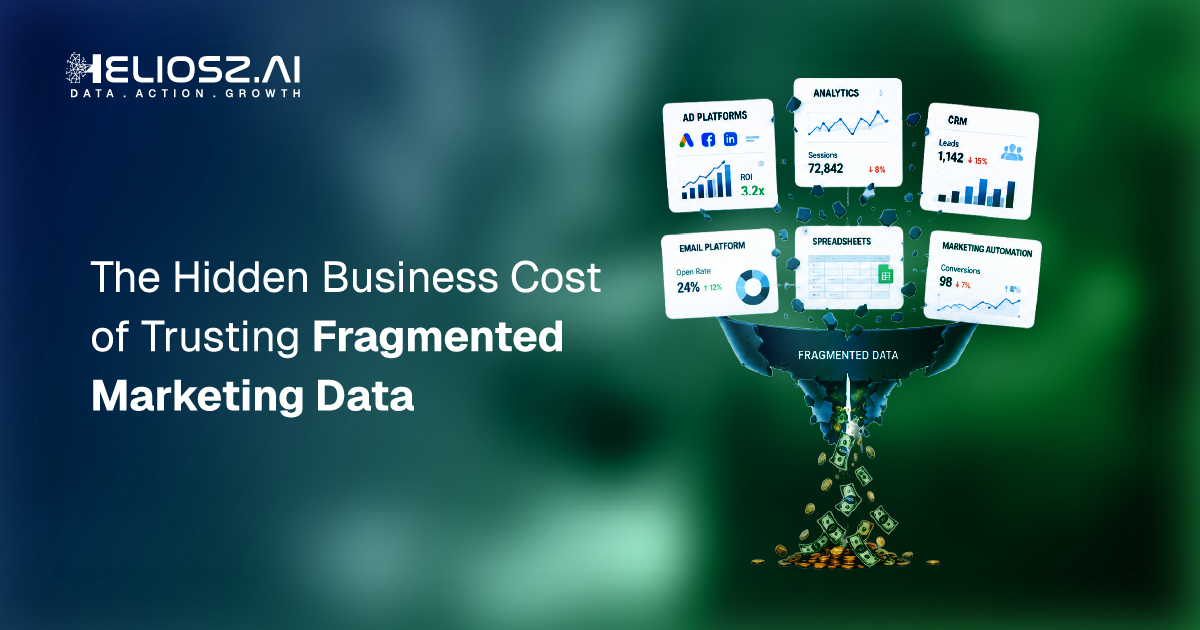
QUICK READ: Hidden Cost of Fragmented Marketing Data
How Marketing Intelligence Differs from Other Terms
People often mix up marketing intelligence with similar terms. Here’s how they actually compare:
| Aspect | Marketing Intelligence | Market Research | Marketing Analytics | Business Intelligence |
| Focus | The full picture (internal + external) | Specific questions about customer behavior | Campaign performance (ROI, clicks, conversions) | Overall company performance |
| Data Sources | CRM, social media, competitor info | Surveys and focus groups | Advertising platforms (Google, Meta) | Company systems (finance, HR, operations) |
| Main Goal | Strategic decisions and future planning | Testing a product or idea | Optimizing current campaigns | Improving total company efficiency |
Understanding these differences helps you choose the right approach for your needs.
Types of Marketing Intelligence Platform
To get a complete view of your market, you need five types of marketing intelligence.
Each type gives you different information. Together, they help you make better decisions.
Here are the five types:
Competitive Intelligence This type helps you track what your competitors are doing. You watch their pricing, ad campaigns, and messaging.
- Example: You see a competitor reduce their subscription price by 15%. In response, you launch a campaign that highlights your better customer service to keep your existing customers.
Customer Intelligence This focuses on understanding your customers’ behavior. It shows how people interact with your website, what they like to buy, and the steps they take before purchasing.
- Example: Your data reveals that many customers abandon their cart on mobile. You then improve the mobile checkout process to make it faster and simpler.
Performance Intelligence These measures how well your marketing efforts are working. It tracks important numbers such as ROI (Return on Investment) and ROAS (Return on Ad Spend) across all channels.
- Example: You notice that LinkedIn ads cost more, but customers from LinkedIn stay with your company twice as long as those from other platforms. This helps you decide where to invest more.
Product Intelligence This type looks at how your products or services perform in the market. It includes customer feedback, common complaints, and missing features.
- Example: Customer reviews show that people like your software but find the setup process difficult. You solve this by creating a simple “Quick-Start” guide.
Industry and Market Intelligence This gives you the broader view. It covers market trends, new government regulations, and economic changes that can affect customer spending.
- Example: A new privacy law changes how you can collect data. You then find new ways to measure your marketing results without breaking the rules.
Key Uses and Benefits of Marketing Intelligence
Marketing intelligence becomes truly valuable when it helps you turn raw data into clear business improvements. Here are the main ways companies actually use it:
Optimizing Marketing Spend It shows you exactly which channels and campaigns are bringing in real revenue. With this knowledge, you can shift your budget toward what works and quickly cut spending on channels that don’t perform.
Personalizing the Customer Experience By studying how customers behave and move through their journey, you can stop sending the same generic messages to everyone. Instead, you can deliver the right content and offers to the right person at the right time.
Identifying Trends and Threats Early Marketing intelligence works as an early warning system. It helps you notice changes in customer preferences or new competitor actions before they hurt your business.
Supporting Market Entry and Product Strategy It gives you solid data to test new ideas. You can discover gaps in the market where your product or service can stand out and succeed.
Strengthening Competitive Positioning By keeping track of how your competitors price and promote their offerings, you can sharpen your own message and make your brand stand out more clearly.
How to Build a Marketing Intelligence Strategy (Step-by-Step)
Creating an effective marketing intelligence strategy requires a clear system that continuously gathers information from multiple sources and turns it into actionable decisions.
Here is a practical, six-step framework that many successful companies follow:
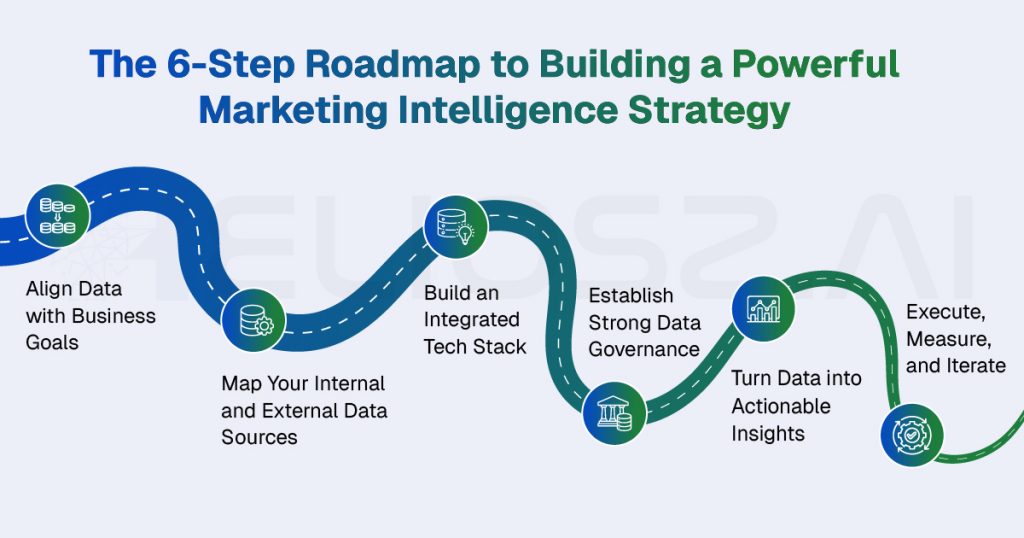
1. Align Data with Business Objectives
The most common mistake companies make is collecting data simply because it exists. Before you gather anything, you must be very clear about your key business goals.
- Are you trying to defend your market share against aggressive competitors?
- Do you want to reduce customer acquisition cost (CAC)?
- Or are you focused on improving customer retention?
Every piece of data you collect should directly support these goals. If a metric does not help you make better decisions or change your actions, treat it as noise and remove it from your system.
2. Build a Complete Data Ecosystem
Good marketing intelligence needs both internal and external data.
- Internal data comes from your own systems. This includes customer behavior from your CRM (Salesforce, HubSpot, etc.) and website analytics. It tells you what your existing customers are actually doing.
- External data gives you the bigger picture. This involves tracking competitor pricing, ad strategies, social media sentiment, and broader industry movements using tools like Semrush, Brandwatch, or Similarweb.
When you combine both views, you stop seeing your company in isolation and start understanding its real position in the market.
3. Set Up an Integrated Tech Stack
Your tools must work together as one connected system instead of operating in separate silos.
A strong foundation usually includes:
- Google Analytics 4 for detailed behavioral tracking
- Semrush or Similarweb for competitor and market intelligence
- HubSpot or Salesforce to track the full customer journey
- Power BI or Tableau to turn complex data into clear, visual reports
The key is having one reliable single source of truth where all data flows together and stays consistent.
4. Maintain High Data Quality and Governance
Even the best strategy fails if the data is messy or inconsistent.
You need clear rules so that definitions match across all tools, for example, “Lead Source” must mean exactly the same thing in both your marketing platform and your CRM. Inconsistent data creates conflicting reports and confusion between teams.
In today’s environment, you must also ensure full compliance with privacy regulations such as GDPR and CCPA. Good governance protects both your insights and your brand reputation.
5. Turn Data into Real Insights
A dashboard only shows you what happened. Marketing intelligence goes further, it explains why it happened and what might happen next.
Train your team to look for meaningful patterns. For instance, if a competitor drops their price and you notice a sudden decline in demo requests, that connection is valuable intelligence. This shift from simple reporting to predictive understanding is what separates average teams from market leaders.
6. Close the Action Loop
Insights are useless unless they lead to action. The final and most important step is turning intelligence into real changes, whether that means shifting budget from a weak channel to a strong one, updating your messaging to counter a competitor, or adjusting your product roadmap based on customer feedback.
After every action, measure the results, learn what worked and what didn’t, and feed those learnings back into the system. Marketing intelligence is most powerful when it runs as a continuous, repeating cycle.
Closing Thoughts
In 2026, success belongs to the company that can turn data into fast, smart decisions.
Marketing intelligence has become an essential skill for any business that wants to compete effectively.
When you move beyond gut feelings and disconnected reports, you stop reacting to yesterday’s results and start preparing for tomorrow’s opportunities.
The real shift happens when you stop asking “What is the number?” and start asking “What should we do next?”
By aligning your data with clear business goals, integrating your tools, and focusing on the insights behind the numbers, you gain the clarity and confidence to lead your market.
Now is the time to take the first step.
Start by reviewing your current data sources. Find the silos that are holding you back and the blind spots that are quietly costing you money. Building a strong marketing intelligence system takes time, but the reward is a faster, smarter, and more profitable business.
The roadmap is clear. The question is: Are you ready to move from guessing to winning? Contact Heliosz today!