Email:
inquiry@heliosz.ai
Email:
inquiry@heliosz.ai Phone: +1 (332) 255-6223



 5 Min Read
Every modern marketing team knows the drill by heart. You open eight different tabs, pull exports from three different ad managers, and spend forty minutes arguing with your team about why the lead numbers in your CRM do not match the numbers in your analytics tool.
Yet, companies keep responding to this mess by buying another software tool, adding another widget, or building one more high-priced dashboard.
What if the problem isn’t the dashboard, but the data underneath it?
Dashboards are useful when the data behind them is consistent, governed, and connected. But when teams are working with fragmented sources, conflicting definitions, and disconnected metrics, adding another visualization layer does little to resolve the underlying problem.
The smarter shift is not away from dashboards, but toward the intelligence foundation beneath them. By connecting data sources, standardizing definitions, and creating a governed intelligence layer, organizations can make every dashboard, report, and decision more reliable.
The Problem with Modern Marketing Tools
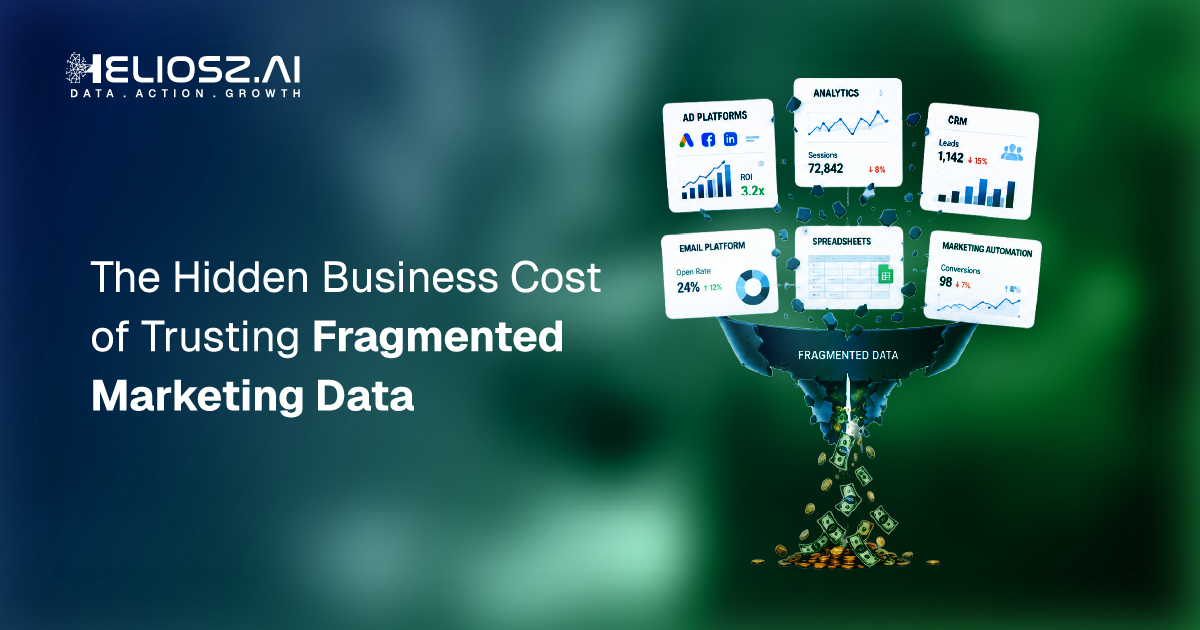
Take a close look at how your team spends a typical Tuesday morning. You have one tab open for email campaigns, another for social media performance, a separate ad manager for paid traffic, and a CRM tracking incoming leads. Each platform tracks success using its own rules, its own definitions, and its own layout.
This setup creates a quiet, daily tax on your time. Instead of executing strategy, your team acts as a human bridge between broken data silos.
- The Tab-Switching Trap: Constantly jumping across ten different apps breaks deep focus and makes it nearly impossible to see the full picture.
- The Spreadsheet Shuffle: Because the tools do not talk to each other, someone has to export raw CSV files, paste them into a master sheet, and manually fix broken formulas.
- The Version Control Argument: When finance asks for conversion costs and sales reports a different pipeline value, your team spends precious hours arguing over whose exported file is correct.
Buying more software does not fix this friction. It only adds another disconnected room to an already crowded house.
READ MORE: What is Marketing Intelligence?
Why Another Dashboard Will Not Fix Your Data Problem?
The default corporate reaction to messy data is simple. Buy a bigger dashboard.
Organizations spend thousands of dollars on enterprise reporting tools, hoping a sleek, custom view will magically bring order to the chaos. Yet, three months later, the team is back to square one. They are staring at a gorgeous wall of charts, but nobody trusts the numbers.
Standard reporting tools share a fundamental flaw. They only look outward at the surface. They sit on top of your mess and display it neatly, but they do nothing to fix the broken plumbing underneath.
Consider what actually happens when you plug a new dashboard into disconnected sources:
- Garbage In, Pretty Out: A polished interface cannot rescue dirty or conflicting data. If your ad platform counts a lead one way and your CRM counts it another, a new visual layout only makes the disagreement look prettier.
- The Definition Trap: Different departments should have different views of the business. The problem starts when they use different definitions for shared metrics like revenue, conversion, or customer value. Different perspectives are healthy; inconsistent definitions are not.
- Maintenance Burnout: Someone has to maintain the connections, update the data pipelines, and fix the widgets every time an ad network changes its API. Your smartest operators end up spending half their week acting as dashboard janitors.
More visualization does not equal better understanding. When you add a new reporting layer on top of unintegrated data, you are not solving the problem. You are just giving your team a faster way to look at bad information.
What Is a Unified Intelligence Layer?
A unified intelligence layer is not just another screen filled with charts. It is the engine working underneath all your software.
Right now, most teams operate in isolation. Marketing tracks clicks in one tool, sales tracks leads in another, and finance looks at spreadsheets to see real revenue. Everyone has a piece of the puzzle, but nobody sees the full picture.
This is where a platform like Optivos comes in. It sits quietly underneath your existing stack to connect those isolated pieces. It takes data from your ad accounts, CRM, and sales channels and applies shared taxonomies, validation rules, and metric definitions, with traceable data lineage back to the source.
Instead of jumping between disconnected systems, teams work from a governed intelligence layer that reconciles source data, standardizes definitions, and keeps the underlying data traceable.
QUICK READ: Multiple Dashboards, Multiple Truths: The Hidden Cost of Fragmented Marketing Data
How to Move Toward a Unified Approach?
Fixing a broken data setup does not mean throwing out all your current software tomorrow. Changing how your organization handles information happens through a practical, step-by-step shift.
Step 1: Map out your current tool stack and find the bottlenecks.
Write down every app your team opens during a typical week. Look for the exact spots where information gets stuck. Pay attention to the moments someone has to manually copy numbers from an ad manager into a spreadsheet just to share results with leadership.
Step 2: Choose architecture that connects data instead of creating more charts.
Stop shopping for software that promises prettier visual widgets. Instead, look for an intelligence layer like Optivos that pulls raw metrics from your marketing channels, sales tools, and financial software into one shared foundation.
Step 3: Make the single source of truth part of daily routines.
Technology fails if humans refuse to change old habits. Show your team how to rely on the new connected platform for everyday planning. When teams use consistent definitions and traceable data, discussions can move from questioning the numbers to deciding what action to take.
Closing Thoughts
The real risk of staying on the old dashboard treadmill is the cost of acting on incomplete or disconnected information while competitors move faster.
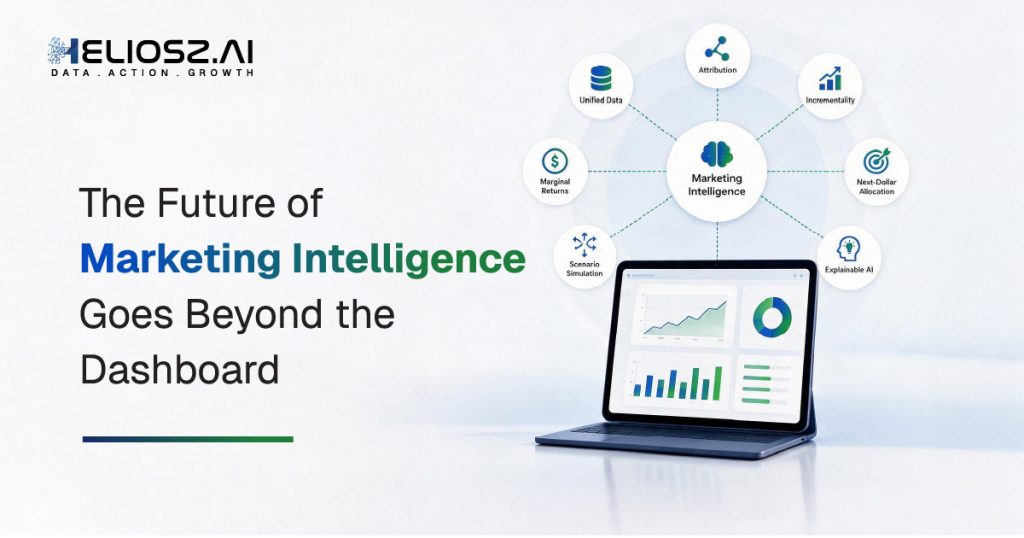
A unified intelligence layer gives teams more than a better way to view data. Optivos brings this foundation together with capabilities such as marketing mix modeling (MMM), unified attribution, incrementality, marginal returns, scenario simulation, and next-dollar allocation. Explainable AI helps teams understand not just what the recommendation is, but why it is being made.
When your marketing data lives in one corner, pricing in another, and revenue somewhere else, your organization is still making decisions in pieces. Optivos connects these signals through a governed intelligence layer, helping teams move from fragmented information to clearer commercial decisions.
The goal is to build the intelligence layer that makes the data from those systems more consistent, traceable, and useful for decision-making.
Take a hard look at your software stack this week. The next step is making sure the intelligence underneath them is strong enough to support the decisions your business needs to make.