 Email:
inquiry@heliosz.ai
 Phone: +1 (332) 255-6223


 5 Min Read
Introduction
Getting this right matters more than most businesses realize. Pricing research from McKinsey found that a 1% price increase lifts operating profit by about 8% for a typical large company, as long as sales volume stays steady. The same math works against you when you cut a price you didn't need to cut.
Most teams already collect plenty of pricing data. Where they struggle is turning those numbers into clear decisions about what to charge, and that's exactly the job a price intelligence platform is built to do.
This price intelligence guide walks you through how pricing intelligence works, where businesses use it, and how to choose the right tool for your team.
Pricing Intelligence at a Glance
-
 It combines competitor prices, customer demand and your own costs to guide what you charge.
-
It goes further than price monitoring, which only tracks prices, and dynamic pricing, which changes them automatically.
-
E-commerce stores, retailers and consumer brands use it to protect margin across every channel they sell through.
-
The right tool depends on your goal, your data and how many channels you sell through.
What Is Pricing Intelligence?
Pricing intelligence is the use of market and business data to set the right price. It shows you where your prices stand against competitors, how customers react to price changes, and how each pricing decision affects your profit.
Two other terms often get confused with it: price monitoring and dynamic pricing. Comparing all three makes it easier to see where pricing intelligence fits.
Pricing Intelligence vs. Price Monitoring vs. Dynamic Pricing
All three use pricing data, but each one answers a different question.
| Capability | Price Monitoring | Pricing Intelligence | Dynamic Pricing |
|---|---|---|---|
| Question it answers | What are competitors charging? | What should we do about it? | What should the price be right now? |
| What it does | Tracks competitor prices and price changes | Adds context like your costs, sales and stock | Updates your prices automatically based on set rules |
| What you get | Alerts and price reports | Clear advice to raise, hold or match | Live price changes |
| Common problem | Too many alerts and no clear next step | Slower when every decision needs approval | Can upset customers if prices change too often |
Knowing what competitors charge is only half the picture, though. The other half is knowing what your own products cost you.
Intelligence Pricing vs. Cost Intelligence
Intelligence pricing tells you what the market will accept, meaning what competitors charge and what customers are willing to pay. Cost intelligence tells you what each product really costs you to make, ship and promote.
You need both views to price well. A price can look competitive and still lose money if your costs have gone up, while a price based only on costs can push customers toward cheaper options.
When you see both sides together, you can set prices that win customers and still protect your margin.
Even price and cost together don't tell the whole story, because sales can change for reasons that have nothing to do with price.
How Pricing Market Intelligence Fits Into the Bigger Picture
When sales drop, price is usually the first thing people blame, but it's often not the real reason.
Unilever saw this with its ice cream business in 2023. Sales volumes fell, and the company linked the drop to shoppers switching to cheaper products and to bad weather in Europe. A price cut wouldn't have fixed either of those problems.
Pricing market intelligence looks at price alongside promotions, product range, distribution and outside factors like weather. That way, you can find what actually changed your sales before you touch your prices.
For consumer brands, this data is usually spread across retailers, distributors, online stores and internal systems. Optivos, a commercial intelligence platform developed by Heliosz.AI for consumer brands, brings marketing, pricing, product, distribution and planning data into one place, so your teams can see the full picture.
Why Does Pricing Intelligence Matter in 2026?
Pricing intelligence matters more in 2026 because companies are raising prices product by product, and shoppers can compare those prices instantly.
Most companies aren't raising prices on everything at once. P&G raised prices on part of its US range, partly to cover higher tariff costs, and Nike described its own increases as "surgical." Research from the New York Fed in 2026 also showed that many companies are still passing tariff costs on to customers, so the trend isn't slowing down yet.
What does this mean for you?
When competitors raise prices on some products and not others, you need to know which ones. Without that view, every pricing decision turns into a guess
Say you raise the price of a product that was already cheaper than most competitors. In that case, customers probably won't mind. If the same product was already the most expensive option on the shelf, though, the increase could send them elsewhere. Where your price sits against the market matters far more than the size of the increase itself.
Pricing intelligence gives you that view, product by product.
Your Customers Are Checking Prices Too
More shoppers now compare prices on their phones while they're standing in the store. If your price is noticeably higher than a competitor's, they can find out in seconds and buy somewhere else.
That puts pressure on every price you set, in store and online. Accurate price intelligence analytics helps you spot where you're out of line before your customers do.
8 Reasons to Use Price Intelligence
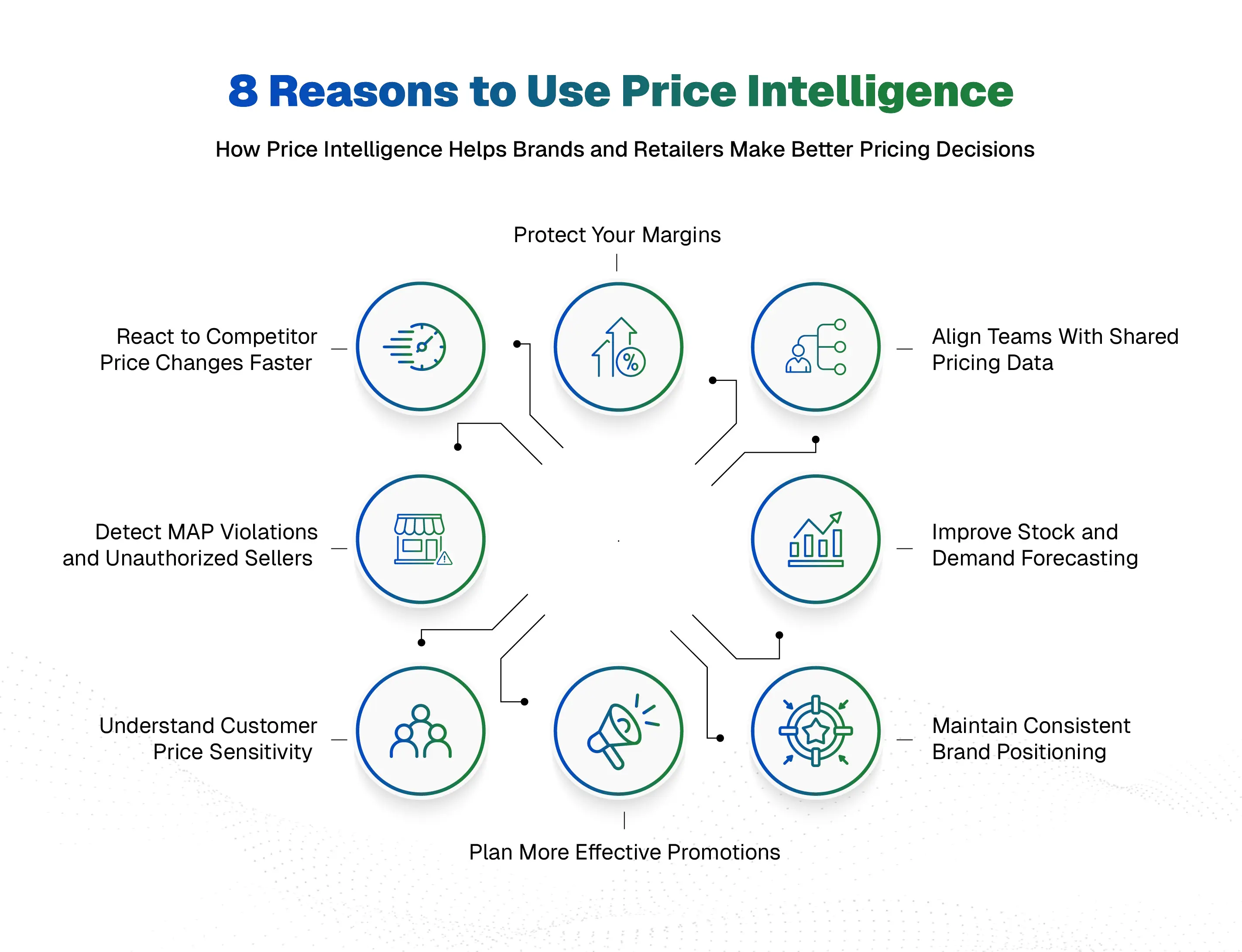
Price intelligence helps in more ways than tracking competitors. These are the reasons to use price intelligence that matter most to brands and retailers.
1. Protect Your Margins
Price intelligence shows you which products have room for a price increase. If you're already cheaper than most competitors on a product, a small increase may not cost you any sales. Without that view, many teams avoid raising prices at all and give up margin they could have kept.
2. React to Competitor Moves Faster
When a competitor drops the price on one of your best sellers, you find out the same day instead of waiting for a monthly report. That gives you time to decide calmly whether to match, hold or respond with a promotion.
3. Catch MAP Violations and Unauthorized Sellers
For brands, this one matters a lot. If one retailer or marketplace seller lists your product below the minimum advertised price, other retailers often match it. One low listing can pull your price down everywhere, so spotting it early protects your price across every channel.
4. Know How Customers React to Price Changes
Some products lose sales after a small price increase, while others barely see any change. Price intelligence helps you spot these patterns before you change a price, so you can raise prices where customers accept them and hold back where they don't.
5. Run Better Promotions
You can see when competitors run discounts and how deep they go. That helps you avoid discounting in the same week as everyone else, or cutting prices when your product is already the best deal on the shelf.
6. Keep Your Brand Positioning Consistent
If your product is meant to be premium, its price needs to stay in the premium range. Tracking the gap between you and competitors keeps that positioning steady, even when the market moves around you.
7. Plan Stock and Demand More Accurately
Competitor prices and stock levels both affect your sales. When a competitor runs out of stock, demand often shifts to you, and you may not need to discount at all. Pricing data makes your sales forecasts more realistic as a result.
8. Get Every Team Working From the Same Numbers
Sales, marketing and finance often use different spreadsheets for pricing decisions. A shared price intelligence platform gives everyone the same data, so meetings move faster when nobody is arguing about whose numbers are right.
How Does Price Intelligence Work?
Price intelligence works in five steps: bringing data together, cleaning and matching it, analyzing it, turning insights into recommendations, and measuring the results. Most platforms look alike in a demo, so the real difference lies in how well each one handles these steps behind the dashboard.
Step 1: Bring All the Data Together
Good pricing decisions need two kinds of data:
-
Your own data: sales history, costs, promotions, stock and distribution
-
Market data: competitor prices, retailer and marketplace prices for your products, and seasonal trends
The challenge is that this data rarely sits in one place. Sales live in the ERP, promotions in spreadsheets, and retailer data in emailed reports. Before any analysis can happen, all of it has to be pulled together.
Step 2: Clean and Match the Data
Next, the data has to be cleaned so you're always comparing the same product. That means comparing prices per unit, separating multipacks from single items, and recognizing one product listed under different names.
Getting this wrong can be costly. Imagine a competitor listing last year's model of a TV under almost the same name as your new one. A tool that only reads product titles will treat them as the same TV and tell you you're overpriced. Systems that also check product details and images make far fewer of these mistakes.
Step 3: Analyze What the Data Means
Once the data is clean, price intelligence analytics turns it into answers, such as:
-
where your price sits against the market
-
how sales respond when your price changes
-
what's eating into your margin
-
which promotions actually brought in extra sales
Price elasticity is the most valuable of these, and also the easiest to get wrong. A product may sell more during a discount simply because of a holiday, not because of the lower price. When a product's price has rarely changed, there's also very little data for a model to learn from. Optivos looks at elasticity and margin drivers together, so you can see both how customers will react and what a change does to your profit.
Step 4: Turn Insights Into Recommendations
When your team gets flooded with alerts, people soon stop reading them. Good recommendations are filtered to focus on the products and competitors that matter most, and they follow your business rules, like minimum margins and price limits.
The system also needs context to make good calls. If a competitor drops its price but has no stock, for example, a good system won't tell you to react.
Step 5: Act, Measure and Learn
Your team then makes the change, either by approving it or by letting the system apply it within your rules.
The step most teams skip is checking the result afterward. Did sales and margin move the way the analysis predicted? Feeding that answer back into the model is what makes each future recommendation more accurate.
Key Pricing Intelligence Use Cases
The steps stay the same across industries, but what you get from pricing intelligence depends on what you sell and where you sell it.
Here's how it plays out in five common types of business.
E-commerce: Real-Time Competitor Tracking and Repricing
Online shoppers can compare prices in a few clicks, so price intelligence software for e-commerce needs to be fast and accurate.
Picture an online electronics store whose headphone sales suddenly drop. At first glance, a competitor looks cheaper, but once delivery charges are added, that competitor actually costs more. So the store keeps its price and highlights its own free delivery instead. Without the full picture, it would have cut its price for no reason.
Retail: Shelf-Price Benchmarking and Promotion Tracking
Retailers can't be the cheapest on every product, so they need to choose where to compete. Retail price intelligence software helps them make that choice.
Take a supermarket whose margin keeps shrinking despite constant promotions. After comparing its prices with nearby stores, it keeps everyday items like milk and bread sharply priced, because shoppers notice those first. It also times its promotions for weeks when competitors aren't running offers in the same category, so its deals stand out. Good retail price intelligence tools show shelf prices and promotion results together, which makes decisions like these much easier.
CPG and FMCG Brands: Channel Pricing, MAP Compliance and Distributor Pricing
Brands don't usually set the final shelf price, but they still feel the damage when it goes wrong.
Imagine a personal care brand hearing from a key retailer that its product is being advertised far cheaper on a marketplace. The brand checks prices across channels and traces the listing back to one distributor's stock. Because the listing breaks its minimum advertised price (MAP) policy, the brand addresses it with the distributor, and prices come back into line.
This is the kind of problem Optivos is designed for, since it gives consumer brands one view of pricing, promotions and distribution across every channel.
Fashion and Apparel Brands: Seasonal Markdowns and Channel Pricing
Fashion has a short selling season, and markdown timing decides how much margin is left at the end of it.
Consider a clothing brand whose winter jackets get discounted earlier on partner sites than in its own stores. Shoppers notice the gap and start waiting for the sale. To fix this, the brand agrees on a shared markdown calendar with its partners and keeps its best-selling styles at full price for longer.
Sports Brands: Launch Pricing Across Retail and Direct Channels
For a sports brand, pricing matters most at the moment a new product launches.
Before launching a new running shoe, a brand reviews where similar shoes sit in the market and how its past launches performed in each channel. It then sets one launch price across specialist stores, large retailers and its own website. To keep direct sales strong, it adds member perks on its site instead of discounts.
What Are the Types of Price Intelligence Tools?
There are four main types of price intelligence tools: price monitoring tools, price optimization and repricing platforms, AI price intelligence software, and market intelligence software with pricing insights. The right one depends on your catalog size, how many channels you sell through, and how much of the decision you want software to handle.
Price Monitoring Tools
These tools track competitor prices and alert you when they change. Because they're quick to set up, they're a common starting point for smaller online stores. The catch is that they only show what changed, so deciding what it means for your margin is still up to your team.
Price Optimization and Repricing Platforms
These platforms take competitor prices and your own rules, then suggest or apply new prices automatically. They suit retailers and online stores with large catalogs that change prices often. Keep in mind, though, that a careless rule like "always match the cheapest seller" can drag your prices down very quickly.
AI Price Intelligence Software
AI price intelligence software uses your sales history, promotions and market data to predict how customers will react before you change a price. It helps you plan prices instead of only reacting to competitors. Its predictions are only as good as your data, however, so products with little sales history will get weaker answers.
Market Intelligence Software With Pricing Insights
This is the broadest category of the four. Market intelligence software with pricing insights looks at price alongside marketing, promotions, distribution and forecasting, so you can see what's really driving sales. It takes more setup than a simple tracker, but it suits consumer brands selling across many channels, and it's the category Optivos belongs to.
Which Type Do You Need?
| Type | Main question it answers | Best for |
|---|---|---|
| Price monitoring tools | What are competitors charging right now? | Small stores with a few competitors |
| Optimization and repricing platforms | What should our price be under our rules? | Large catalogs with frequent price changes |
| AI price intelligence software | How will customers react to a price change? | Teams planning prices ahead |
| Market intelligence software with pricing insights | What's really driving our sales and margin? | Consumer brands across many channels |
Many businesses start with monitoring and move to broader price intelligence platforms as they grow, usually once competitor prices alone stop explaining why sales are changing.
Must-Have Features in a Price Intelligence Platform
Seven features separate a useful price intelligence platform from one that only looks good in a demo: data coverage, product matching, alerts, elasticity modeling, integrations, governance and scalability. Since most vendors claim their tool does everything, the questions below are built to get past the sales pitch.
| Feature | Why it matters | What to ask the vendor |
|---|---|---|
| Data coverage and refresh rate | You can only act on the channels and prices the tool can see | Which channels, retailers and regions do you cover, and how often is the data updated? |
| Product-matching accuracy | Wrong matches create price gaps that don't exist | Can you show us real matches from our own catalog, including tricky pack sizes? |
| Alerts | Too many alerts get ignored, while too few miss real changes | Can we filter alerts by product, competitor and size of change? |
| Elasticity modeling | It shows how customers will react before you change a price | How do you handle products with very little price history? |
| Integrations | Good decisions need your own sales, cost and stock data | Which of our systems can you connect to, and how long does setup take? |
| Governance and data ownership | Pricing and margin data is highly sensitive | Who owns our data, who can see it, and is every change recorded? |
| Scalability across SKUs and markets | A tool that works for one market may struggle as you grow | How do speed and cost change as we add products, markets and users? |
The most useful test is also the simplest one. During a trial, ask the vendor to run your own products through the tool instead of showing a prepared demo. How a pricing intelligence solution handles your messy, real data will tell you far more than any feature list.
How Do You Choose the Right Pricing Intelligence Solution?
To choose the right pricing intelligence solution, define your goal, check your data, list your systems, run a pilot and measure the return. These five steps help you avoid a common trap, where a team gets impressed by a demo, buys the tool, and only later realizes it doesn't fit how they work.
1. Define Your Goal First
Decide what you need before you look at any tool. Do you just want to see competitor prices, get price recommendations, or understand everything that drives your sales and margin? Your answer points you to one of the tool types covered earlier and stops you from paying for more than you need.
2. Be Honest About Your Data
If your sales, cost and promotion data is scattered across spreadsheets, even the smartest tool won't give reliable answers straight away. Pick a solution that can help you bring that data together first, rather than one that assumes it's already clean.
3. List Your Systems Before Speaking to Vendors
Write down where your data lives, such as your ERP, sales reports, retailer data and online stores. Then use the features checklist above to see how each vendor handles those systems, along with data ownership. Vendors tend to give clearer answers when you ask about your actual setup.
4. Run a Pilot on One Category
Rolling out a new tool across the whole business at once is risky. Start instead with one category that has enough sales history, regular competitor or promotion activity, and a team that's ready to act on the recommendations. Then use the tool for a few real decisions, like pricing a promotion or reviewing a price increase.
5. Measure the Return
Agree on how you'll judge success before the pilot begins, so you have a clear starting point. Three useful measures are:
-
Margin: Did profit improve on the pilot products?
-
Sales volume: Did you keep your customers while adjusting prices?
-
Promotion lift: Did promotions bring in more extra sales than before?
Check out our latest guide: MMM vs MTA vs Incrementality Testing
Also track the time your team saves on reports and how much easier decisions become. If the pilot delivers on these measures, you'll have a strong case for rolling the solution out further.
Once you know what to look for, it helps to see how a specific platform fits these criteria.
Best Price Intelligence Software to Consider in 2026
The best price intelligence software is the one that fits the way your business sells.
Optivos by Heliosz.AI
Optivos is a commercial intelligence platform built for consumer brands in FMCG, CPG, retail, fashion and apparel, and sports. It's designed for businesses whose pricing decisions depend on data spread across many teams and channels.
Seven configurable modules
-
Marketing & Commercial Intelligence
-
Unified Data & Business Visibility
-
Pricing & Revenue Intelligence
-
Product & Distribution Intelligence
-
Digital Commerce Intelligence
-
Forecasting & Operational Planning
-
Pricing & Promotion Intelligence
You can start with the module you need most and add others as your priorities grow.
How it handles pricing
The Pricing & Revenue Intelligence module looks at price elasticity and margin drivers together. Custom dashboards track your key metrics, while the forecasting tools help you plan ahead with more confidence.
Deployment and data ownership
For companies that prefer a subscription-based pricing intelligence solution, Optivos runs as a cloud SaaS platform. If your business has stricter data requirements, you can install it within your own environment instead. Either way, you keep full ownership of your data, with role-based permissions and audit trails built in.
Who it's for
Optivos suits mid-size and large consumer brands and retailers that sell across several channels, and it's backed by Heliosz.AI's hands-on data and AI services team. You can request a demo set up around your own data, so you see how it works with your business rather than a sample one.
Common Challenges (and How to Solve Them)
Most pricing intelligence challenges don't show up in a demo. They tend to appear a few months in, once the tool becomes part of everyday work.
Inaccurate Product Matching
Product matches don't stay accurate on their own. Competitors relaunch products, change pack sizes and update product names, so a match that was right in January can be wrong by June.
The fix is to give someone on your team clear ownership of match quality. A quick monthly review of your best sellers will catch most problems before they affect a pricing decision.
Data Silos Across Teams
Bringing data into one place is only half the job. If the pricing and finance teams calculate margin differently, they'll still disagree, even when they're looking at the same dashboard.
Agree on one definition for each key measure, like margin, promotion lift and price position, before you start reporting on them. A shared platform like Optivos makes this easier, but the agreement itself has to come from the teams.
Reacting to Every Competitor Move
A competitor cuts its price, you match it, and then they cut again. A few rounds later, both of you are selling at thin margins without gaining many customers.
The best way to avoid this is to decide your response rules in advance. Agree on which competitors you'll follow, which ones you'll ignore, and when a bundle, faster delivery or a loyalty offer makes more sense than a price cut. That way, nobody makes a rushed decision the moment an alert arrives.
Relying on Automation Without Guardrails
Automation can quietly go wrong during unusual periods, like a big sale event or a competitor's pricing error. Prices can move fast before anyone on the team notices.
Review automated price changes regularly, even when everything seems fine. During major sales or market shocks, it's often safer to pause automation on your most important products and let your team make those calls directly.
Closing Thoughts
Right now, a shopper is probably looking at your product next to two others. They aren't thinking about your costs or your targets. What they're asking themselves is whether your price feels fair compared with everything else in front of them.
Pricing intelligence helps you see that moment the way your customer does, before it turns into a lost sale or a discount you never needed to give.
You don't have to fix every price at once. Think about the one pricing decision that's been bothering you most, whether it's a price increase you keep delaying, a promotion that never pays off, or a channel where your product always looks cheaper than it should. That decision is your starting point.
If you're a consumer brand that wants pricing connected to the rest of your commercial data, book a demo of Optivos by Heliosz.AI and see what it shows about your own pricing.