Email:
inquiry@heliosz.ai
Email:
inquiry@heliosz.ai Phone: +1 (332) 255-6223



 5 Min Read
Brand building will never be the same again.
AI has entered the arena and it is changing everything. How brands connect with people, how they create, and how they grow. What used to be slow, expensive, and based on guesswork is now becoming faster, smarter, and deeply personal.
Personalization that actually feels personal. Creative ideas generated in minutes instead of weeks. Systems that do not just follow instructions but can think ahead and act on their own.
It is exciting. But it is also a little unsettling.
Because while some brands are using AI to build stronger, more adaptive identities, others are rushing forward without understanding the full picture. And that is where mistakes happen.
If you are wondering how AI is truly disrupting brand building, what opportunities it opens up, where the hidden risks are, and how you can stay ahead instead of falling behind, then keep reading. This is going to be useful.

The Evolution of Brand Building in the AI Era
Brand building has shifted dramatically in a very short time. What once depended on intuition, long campaigns, and limited feedback loops is now powered by intelligent systems that learn and adapt continuously.
Traditional Limitations
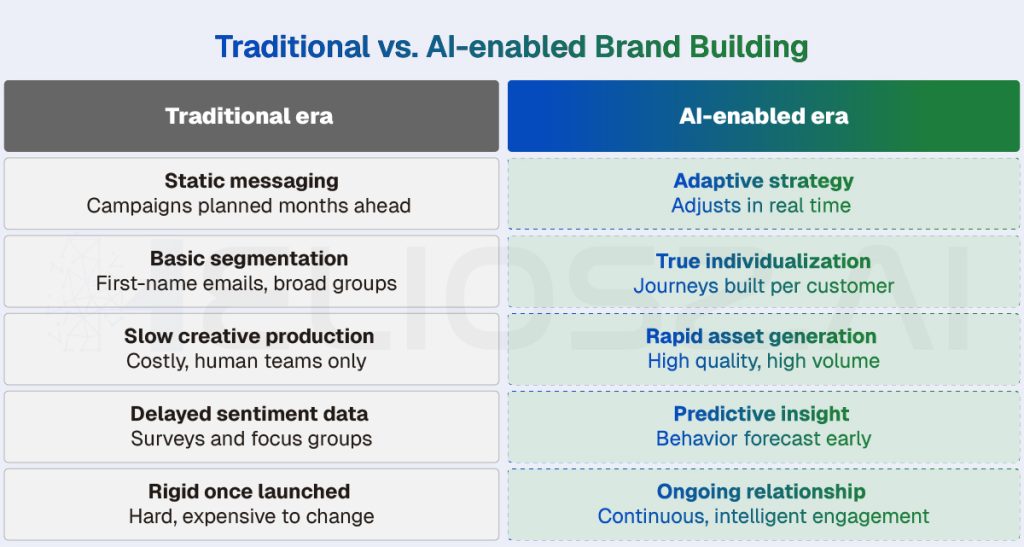
In the pre-AI era, brand building faced several constraints. Campaigns were planned months ahead with static messaging. Personalization was basic at best, usually limited to first-name emails or broad audience segments.
Creative production was slow and costly, relying entirely on human teams. Understanding customer sentiment depended on delayed surveys and focus groups. Once a campaign launched, making real-time changes was difficult and expensive. This often resulted in brands feeling distant and one-dimensional to their audience.
AI-Enabled Possibilities
AI has removed many of these barriers. Brands can now deliver truly individualized experiences, generate high-quality creative assets rapidly, predict behavior with greater accuracy, and adjust strategies in real time. The focus has moved from broadcasting messages to building ongoing, intelligent relationships.
Key Timeline of Shifts (2023–2026)
- 2023: Generative AI entered mainstream marketing. Tools like ChatGPT and DALL-E allowed brands to produce content 5-10x faster, sparking the first wave of experimentation.
- 2024: AI integration deepened. Predictive analytics became a core marketing capability, helping brands improve audience segmentation, personalize campaigns, and optimize marketing performance through data-driven decision-making.
- 2025: AI-powered search started reshaping discovery. Reports showed that AI chat interfaces began influencing a growing portion of purchase decisions, pushing brands to optimize beyond traditional SEO.
- 2026: The rise of agentic AI. Autonomous AI systems now manage end-to-end campaign elements, enabling smaller teams to deliver results previously requiring much larger groups.
This rapid evolution means brands today must think differently, not just about using AI tools, but about reimagining their entire approach to building lasting customer connections.
Hyper-Personalization at Scale
AI can now deliver real-time, individual customer journeys across every channel. The experience changes based on customer behavior, context, engagement patterns, and inferred intent.
Here is the red pill. Most companies think they are doing personalization, but they are still stuck with fragmented data. Without clean, connected data, your personalization feels fake. This is exactly where our Connected Commercial Intelligence approach makes the difference. It unifies data across sources so brands can finally deliver personalization that feels genuine and intelligent. The brands winning here are the ones building serious customer data foundations. Everyone else is just playing pretend.
Generative AI Transforming Creative & Content
Generative AI lets you create ads, videos, copy, and designs at crazy speed and volume.
But there is a catch. As everything becomes easy to produce, real creativity and authenticity become extremely valuable. If you replace your brand voice with generic AI output, you will slowly kill what makes your brand special. Smart leaders use AI as a multiplier, not a replacement.
Agentic AI & Autonomous Brand Operations
This is the big one in 2026. AI agents are no longer just tools. They act like teammates. They can plan campaigns, adjust in real time, and run large parts of brand execution.
For executives, this changes everything. Team sizes, budgets, and who you hire. Companies that figure this out early will operate with much lower costs and much higher speed. The rest will feel the pressure.
AI-Powered Search & Brand Discoverability
Traditional SEO is evolving as AI-powered search experiences increasingly complement conventional search engines. People now ask AI chat tools questions, and those tools answer by pulling from many sources. Often skipping brand websites completely.
Hard truth. If your brand is not showing up in AI answers, you are becoming invisible to the next generation of customers. This requires a totally different strategy than old-school SEO.
Predictive Analytics & Consumer Insight Revolution
AI now lets you predict what customers will want before they know it. You can see trend shifts and sentiment changes early.
The strategic advantage is huge. Brands that invest seriously in data and analytics will lead the market. Companies still relying on old reports will always be one step behind.
Why Data Engineering Is the Foundation of Successful AI Branding
Here is the uncomfortable truth most executives miss.
The biggest bottleneck in AI branding is not the AI models. It is the data. Companies invest millions in flashy AI tools, but if the underlying data is fragmented, outdated, or inconsistent, the entire effort collapses into expensive mediocrity.
The Real Cost of Fragmented Data
When customer information sits in silos, AI cannot create a true understanding of the customer. Personalization becomes surface-level. Predictive models make wrong assumptions. Agentic AI makes bad decisions because it is operating on incomplete information.
The result? Brands spend heavily on AI, yet customers still feel the experience is generic or even creepy. Trust erodes. ROI stays low. And the company quietly falls behind competitors who have solved this foundational problem.
What High-Quality Data Engineering Actually Unlocks
Modern data engineering is what separates serious players from the rest. It does three critical things:
- It builds robust pipelines that continuously integrate data from every customer touchpoint in real time.
- It creates unified customer graphs that connect behavior, preferences, transactions, and context into one accurate profile.
- It enables real-time processing, so AI systems can adapt instantly instead of working with yesterday’s data.
This is not just “cleaning data.” It is turning raw information into a strategic asset that powers genuinely intelligent branding.
Without this foundation, all the talk about hyper-personalization, agentic AI, and predictive insights remains mostly hype. With it, AI branding moves from experimental projects to sustainable competitive advantage.
For leaders who want real transformation, the priority is clear. Fix the data foundation first.
Risks and Challenges of AI in Brand Building
While the opportunities are significant, C-level leaders must face the risks head-on. Ignoring them can turn AI from a competitive advantage into a brand liability.
The Authenticity and Trust Crisis
As generative AI floods the market with content, customers are becoming better at spotting synthetic experiences. Brands that overuse AI without human oversight risk looking generic, manipulative, or even deceptive. In a world where trust is the ultimate currency, this can cause long-term damage to brand equity that is very expensive to repair.
Ethical and Regulatory Landmines
Bias in AI models, privacy violations, and lack of transparency are no longer just compliance issues. They are brand reputation risks. Regulators are tightening rules, and customers are increasingly punishing brands that cross ethical lines. Leaders who treat this as a legal checkbox instead of a strategic priority will face sudden backlash.
Over-Reliance and Talent Gaps
Many organizations are replacing human judgment with AI too quickly. This creates dangerous blind spots. At the same time, there is a serious shortage of people who understand both AI technology and brand strategy. Without the right talent mix, companies end up with powerful tools but poor strategic direction.
The Visibility Risk in AI Search
If your brand is not structured properly for AI-powered search and chat interfaces, you could slowly disappear from customer discovery channels, even if traditional search rankings look fine.
Strategic Recommendation
Treat these risks as board-level concerns. Build governance early, maintain strong human oversight on critical decisions, and invest in talent that can bridge technology and brand thinking. The brands that succeed will be those that use AI boldly but responsibly.
Future Outlook – Branding Beyond 2026
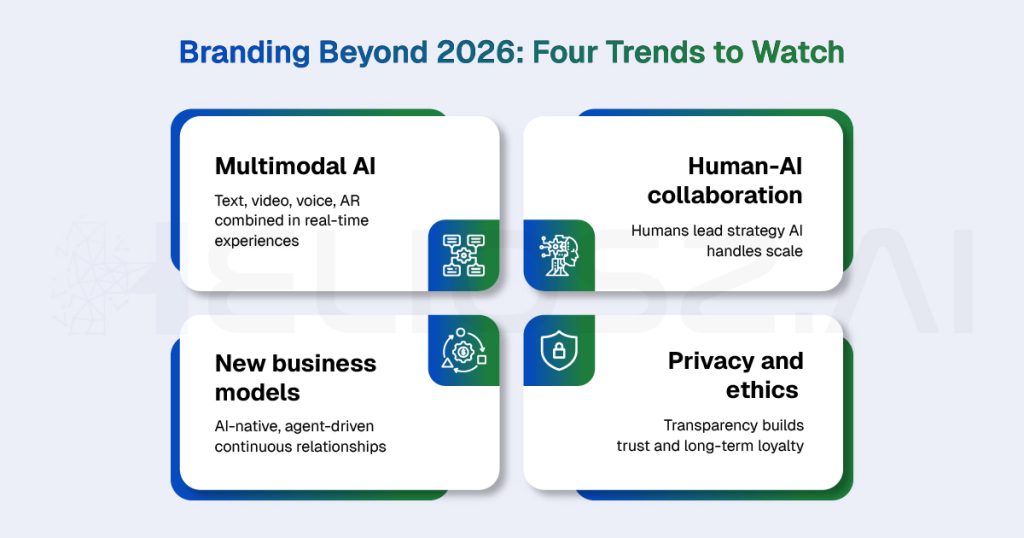
Multimodal AI: Brands will use AI that combines text, video, voice, and AR in real-time personalized experiences. Early preparation will create big advantages.
- Human-AI Collaboration: The winning model will be humans focusing on strategy and emotion while AI handles scale and optimization. Pure automation will lose to smart collaboration.
- New Business Models: Expect AI-native brands with dynamic offerings, continuous relationships, and agent-driven operations.
- Privacy and Ethics as Advantage: Brands that lead in transparent and responsible AI will build stronger trust and long-term loyalty.
Closing Thoughts
AI has permanently changed brand building. It is no longer a futuristic idea. It is the new reality.
The brands that thrive in the years ahead will be the ones that go beyond simply using AI tools. They will build it into their strategy with solid data foundations, strong human oversight, and responsible governance.
The upside is clear. Faster innovation, stronger customer relationships, and lasting competitive advantage. But the risks are serious for companies that move too fast without proper preparation.
Technology will continue to evolve rapidly, yet the heart of great branding stays human. Trust, relevance, and emotional connection. The best leaders will use AI to strengthen these qualities, not replace them.
If your organization is serious about turning AI into a real advantage for your brand, the right time to start building the foundation is now.