Email:
inquiry@heliosz.ai
Email:
inquiry@heliosz.ai Phone: +1 (332) 255-6223



 5 Min Read
When ten different leaders define marketing intelligence, you get ten different answers.
Some think it is just another dashboard for ad metrics. Others treat it like basic competitor research or weekly sales reports. That confusion costs money. Teams end up buying expensive software they never open, or they drown in numbers that do not help them make a single real choice.
What if the missing piece in your growth strategy is not a bigger budget or a sharper creative team, but a clear window into what your market is doing right now?
This guide breaks down what marketing intelligence platform actually is, why it matters for your revenue, and how to use a reliable market intelligence platform without getting buried in useless data. We will look at how it differs from basic research, what information you actually need to track, and how to spot market changes before your competitors do.
What Is Marketing Intelligence?
Marketing intelligence is the everyday process of gathering, analyzing, and using data about your market, your competitors, and your buyers.
Instead of guessing what your audience wants or reacting only to your own sales numbers, you look outward. You track what rival companies are launching, how industry costs are changing, and what buyers expect from products like yours.
Think of it as your business having an early warning system. It gives you the clear facts you need to set prices, build better features, and spend your ad budget where it will actually bring in revenue.
Types of Marketing Intelligence
Gathering intelligence takes a mix of methods to capture what people say, what they do, and how the market reacts. Relying on just one data source leaves blind spots that cost real revenue.
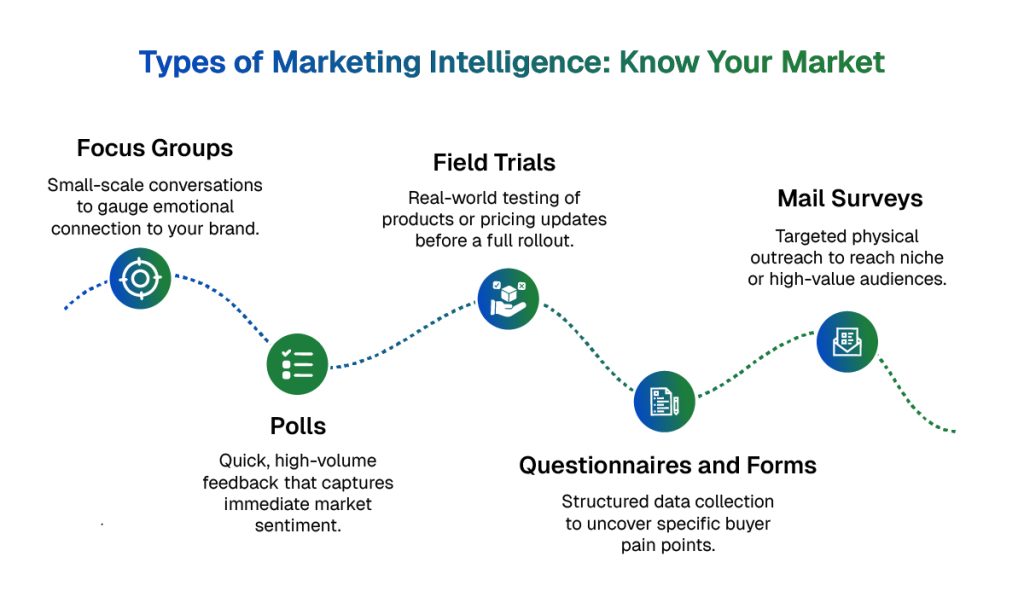
Focus Groups
Focus groups bring together a small, targeted group of actual buyers to talk about a product, feature, or campaign concept in real time.
- The benefit: You get direct, unfiltered reactions to your messaging before you spend money rolling it out.
- The downside: Participants can sometimes give the answers they think you want to hear instead of their true opinion. Use focus groups to test emotional connection, not hard pricing logic.
Polls
Polls capture quick, high-volume feedback through websites, social channels, or dedicated research platforms.
- The benefit: They take very little effort from the respondent, which means you get large sample sizes fast.
- The downside: Depth suffers. A quick poll tells you that buyers prefer Option A over Option B, but it cannot explain the frustration driving that choice.
Field Trials
Field trials test a product, feature, or pricing update in a live environment with a small slice of your real audience before a full-scale launch.
- The benefit: What people actually do always beats what they say they will do. Watching how buyers interact with a new tier in the wild exposes flaws that surveys completely miss.
- The downside: They take time to set up and need careful tracking so a single broken variable does not ruin the results.
Questionnaires and Forms
Structured questionnaires and website forms turn passive traffic into organized feedback.
- The benefit: You collect specific details about buyer pain points right when those prospects are actively looking for answers.
- The downside: Completion rates drop fast if your forms ask for too much. Keep fields short to protect your conversion rates.
Mail Surveys
Physical mail surveys might feel old-fashioned, but they still work well for specific audiences, especially in enterprise sectors where executives ignore digital inbox clutter.
- The benefit: Physical mail often reaches decision-makers who delete cold emails on sight.
- The downside: Response times are slow, and printing costs add up. Save mail surveys for high-value enterprise research, ensuring your market intelligence platforms capture both digital and offline feedback.
Marketing Intelligence vs. Marketing Research
While people often use these terms interchangeably, they solve two different problems. When looking at market intelligence vs market research, you will notice that research looks backward and inward to answer a specific question about a single product or campaign, while intelligence looks outward and forward to track ongoing shifts across your entire market.
| Feature | Marketing Research | Marketing Intelligence |
| Primary Objective | Solve a specific, isolated problem or test a single idea. | Provide ongoing visibility into market trends, competitors, and buyers. |
| Time Horizon | Project-based and retrospective. Usually has a clear start and end date. | Continuous and forward-looking. Runs in the background every day. |
| Core Focus | Internal products, customer satisfaction scores, or single campaign feedback. | External competitor moves, macro industry shifts, and broader buyer behavior. |
| Decision Impact | Helps you greenlight a specific feature, logo redesign, or ad variation. | Helps you adjust your entire go-to-market strategy, pricing model, and positioning. |
What Does Marketing Intelligence Include?
If someone hands you a project to map out the market, you cannot just look at one piece of the puzzle. Putting together a clear view means gathering four different types of information. Leave one out, and you end up making big bets on half-truths.
Here is what actually goes into the mix.
Competitive Intelligence
This goes way beyond saving a rival pricing page once a quarter. You want to track how their ads, product updates, and messaging change as they happen by using competitive marketing intelligence to stay a step ahead.
When a competitor shifts their main pitch from enterprise scale to fast mid-market setups, they are showing you where they see an opening. Spotting that move early lets you protect your accounts before your sales reps start losing deals.
Product Intelligence
This pillar looks at how your products and your competitors’ items actually perform out in the wild.
Instead of guessing based on internal development roadmaps, you track feature adoption, pricing tiers, and direct user feedback using modern market intelligence software. If buyers constantly complain about a missing integration in your rival’s software, you have an open lane to highlight your own capability in your next campaign.
Market Understanding
This gives you the big-picture view of your entire industry.
You are tracking market size, growth rates, new rules, and cost pressures to navigate an intelligent market successfully. If wider economic shifts force companies to cut software bloat, knowing that trend early lets you change your pitch from an all-in-one platform to a focused tool that cuts specific costs right away.
Consumer Understanding
Buyers change how they evaluate and purchase products faster than annual reports can keep up.
This part covers shifting pain points, communication channels, and shopping habits. By pulling fresh market intelligence data, you can see right away if decision-makers stop filling out long demo forms and start relying entirely on peer communities for product research, so your inbound funnel shifts to match that habit immediately.
What Is a Marketing Intelligence Strategy?
A marketing intelligence strategy is simply your plan for gathering, organizing, and acting on market data before your competitors beat you to it.
Most teams treat data collection like a fire drill. They scramble to pull competitor numbers only when a campaign fails. A real strategy replaces that scramble with a steady workflow powered by the right market intelligence solutions. It tells you what to track, where to find it, and how to use it.
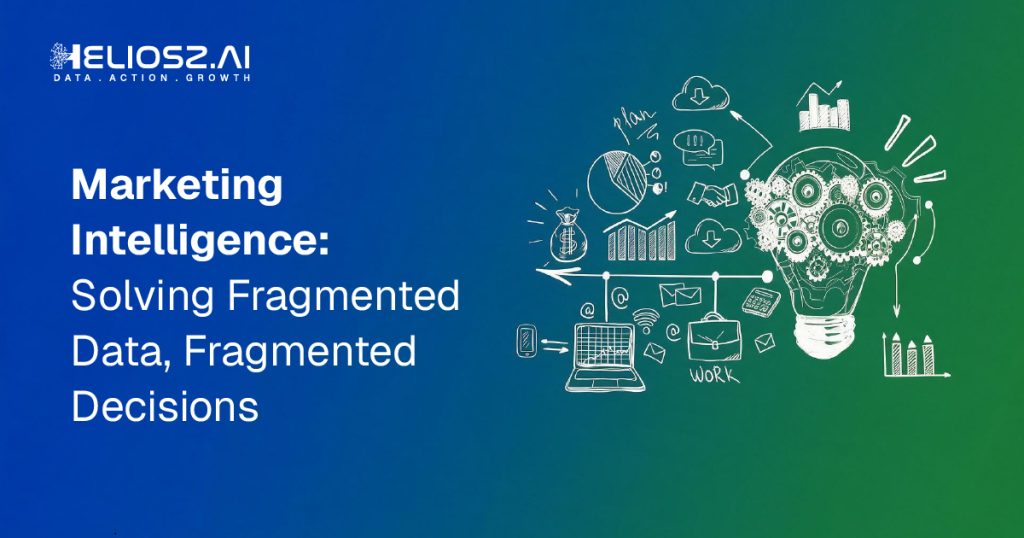
Fragmented Data Creates Fragmented Decisions
The biggest problem facing marketing teams is the fact that critical signals are scattered across systems, teams, and channels.
Campaign performance sits in advertising platforms. Customer behavior lives in CRM systems. Revenue data sits in the ERP. Competitor activity comes from research, websites, and social channels, while broader market movements may sit inside syndicated reports or spreadsheets.
Each source is useful on its own. The problem begins when a business needs to connect them.
That is fragmented data: different parts of the business seeing different pieces of the same commercial reality.
And when context is fragmented, decisions become fragmented too.
A marketing leader may see declining conversions and increase campaign spend. Sales may be seeing customers delaying purchases because of pricing pressure. Product may be noticing rising demand for a capability competitors already offer.
None of these teams is necessarily wrong. They are simply responding to different signals.
QUICK READ: Hidden Cost of Fragmented Marketing Data
From Data Silos to One Decision Context
Marketing intelligence addresses this gap by connecting signals rather than simply accumulating them.
Competitive activity, customer behavior, market conditions, product performance, and business results need to be viewed together so leaders can move beyond what happened to understand what changed, why it matters, and where to act.
Consider a drop in campaign conversions. Viewed alone, it looks like a channel-performance problem. Connect it with competitor promotions, pricing changes, shifting buyer behavior, and pipeline movement, and it could point to something much larger: a change in how the market is making purchasing decisions.
That distinction has commercial consequences.
The value comes from turning isolated signals into decision context. Marketing can adjust investment with a clearer understanding of demand. Product teams can prioritize capabilities against emerging needs. Sales can respond to competitive pressure earlier. Leadership can align these moves around the same market reality.
The objective is to create a connected view that helps the business recognize a change early, understand its significance, and coordinate the response before a small market shift becomes a larger revenue problem.
Examples of Marketing Intelligence Strategies
Seeing how marketing intelligence works in practice makes it much easier to apply. Here are four ways companies use external data to drive real growth.
Product Development
Building new features based only on internal requests is a fast way to build tools nobody wants to buy.
Marketing intelligence changes that process. By tracking competitor gaps, industry shifts, and direct buyer feedback using specialized market intelligence tools, your product team builds things the market is actively asking for. You spot missing integrations or pricing tier mismatches early, ensuring your next release solves a real problem on day one.
Market Segmentation
Targeting everyone usually means selling to no one.
Market intelligence helps you break your audience into sharp, high-value segments based on how they actually behave today. Instead of relying on broad company size or basic job titles, you group buyers by their current pain points, tech stacks, and buying habits. That lets you speak directly to their specific needs.
Customer Lifetime Value
Winning a customer is only half the battle. Keeping them around determines your long-term success.
Intelligence data shows you why high-value clients stay and why others churn. When you track shifting buyer expectations and competitor offerings, you spot the warning signs of churn months before a customer cancels their contract. That gives your team time to fix the issue and protect your revenue.
Campaign Optimization
Throwing budget at ads and hoping something sticks wastes cash.
Marketing intelligence keeps your campaigns sharp by showing you where buyer attention is moving right now. If competitors start flooding a specific channel and driving up costs, you spot that shift and move your budget to open spaces where your audience is actually paying attention.
Closing Thoughts
Marketing intelligence is not just another dashboard to look at or a task to check off your list.
It is the shift from guessing what your market wants to knowing it for sure.
When you stop driving your business while staring only in the rearview mirror, everything changes. You stop reacting to what your competitors did months ago. You stop wasting ad money on places your buyers no longer hang out. And you stop building products based on guesswork instead of what people actually need.
You do not have to fix everything at once.
Start small. Pick one blind spot in your current plan, like figuring out what your top rival just changed or finding out why your favorite clients stick around so long. Gather the facts, look at the signs, and make your next move based on where the market is going tomorrow, not where it was yesterday.