
 5 Min Read
What breaks first when an enterprise brand puts AI to work across marketing? In most cases it isn’t the AI, and it isn’t the platform it runs on. What breaks first is the quality of the decisions coming out the other side.
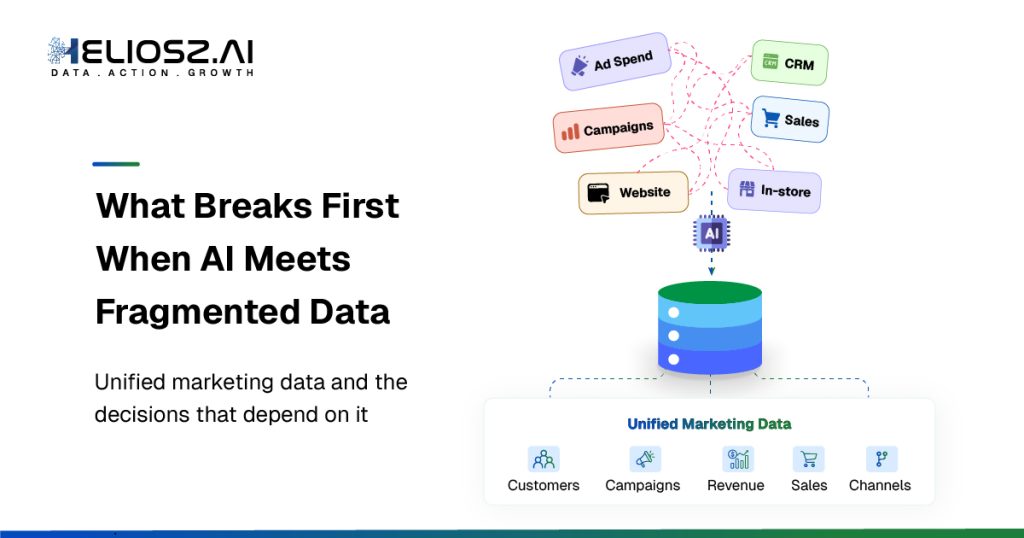
Most marketing organizations hold years of customer, campaign, sales and channel data that sits in different places, tells slightly different stories, and gets measured in different ways. People learned to work around those marketing data silos years ago, and the workarounds became invisible. AI doesn’t remove the gaps so much as make them considerably harder to see.
An analyst who hits two conflicting conversion figures stops and asks which one is right, whereas an AI system never stops to ask. It builds a recommendation from whichever figure reached it first, and that recommendation arrives looking exactly as authoritative as a correct one would. Fragmented data doesn’t slow AI down, which is the part that catches leadership teams out; it lets the organization make the wrong call faster, at scale, behind a very clean interface.
What Is Unified Marketing Data?
Unified marketing data means connecting the data a business needs to make marketing decisions, whether that data remains in one system or across multiple systems. Media spend, campaign results, sales, pricing, CRM records, website activity, store purchases, and market signals can be connected through common definitions, identity resolution, and governance. The goal is to make the relevant data consistent, connected, and usable for the decision at hand.
Unified marketing data fixes this problem. It means:
- One clear source of truth. Revenue, engagement, and market numbers all match up instead of showing different answers in ten different dashboards.
- Automated data flow at the required frequency. Information moves between systems automatically at the frequency the use case requires, whether that means hourly, daily, or weekly, instead of depending on manual uploads.
- Connected customer view. A customer’s ad click, purchase, and support interaction can be connected into a broader journey where identity, data availability, and consent allow, rather than being treated as unrelated events across separate systems.
- Data that AI can actually use. Clean, connected information an AI tool can read and understand, instead of messy pieces it has to guess about.

What Breaks First Without Unified Marketing Data
The sequence matters here, because the order in which things break is roughly the inverse of the order in which anyone detects them.
Customer Understanding Degrades Silently
Salesforce’s Tenth Edition State of Marketing report found that marketers have complete access to:
- 58% of service data
- 56% of sales data
- 51% of commerce data
So the model may lack important customer context, such as whether that customer filed a complaint last week or returned a product last month. Nothing necessarily throws an error or crosses a threshold; relevance simply erodes, and nobody can point to the day it started. That silence makes this the most expensive failure of the four, because performance can drift down over two or three quarters while the post-mortem ends up blaming the creative or the market.
Unified Marketing Measurement Breaks Next
AI optimizes the proxy it has been given rather than the outcome the business actually cares about. Feed a bidding system last-touch conversions and it will maximize last-touch conversions beautifully while contribution margin slides underneath. The algorithm is doing its job correctly; it has simply been aimed at the wrong target.
That’s Goodhart’s law running at machine speed, and it surfaces late because the dashboards keep improving right up until finance asks why revenue didn’t follow. Without unified marketing measurement, every channel gets graded against its own scoreboard, which is how a company posts a strong quarter in each platform while commercial performance flattens.
Automation Multiplies Whatever Is Already There
A duplicate customer record used to cost you one inaccurate report that an analyst would eventually catch. Inside an agentic system, that same record becomes a wrong-person message, a broken frequency cap, an inflated audience count and a bid decision, replicated across thousands of interactions before a human reviews any of them. The underlying defect hasn’t changed at all; only the blast radius has.
Worth putting a blunt question to your team: if a bad identity match entered the system on Monday morning, when would anyone find out, and who holds the authority to roll it back? If the honest answer involves a weekly report and a Slack thread, the system is already running faster than the controls around it.
Trust Becomes A Board Problem
Salesforce found that 81% of marketers would trust AI to respond to customer inquiries, while disjointed data remains the barrier holding them back, and IBM points the same way from the governance side, with only 21% of organizations believing they have the structures agentic AI requires. Adoption stalls inside companies that genuinely believe in the technology, because nobody will stake a customer relationship on numbers they can’t personally vouch for.
You Probably Shouldn’t Unify Everything
Here is the part most vendor content quietly leaves out. Enterprise-wide data unification is a multi-year program, and plenty of companies have bought the data unification platform, migrated diligently and never activated any of it. Treating full unification as the goal is how these initiatives die in year two, when the sponsor changes roles and the value story is still theoretical. A narrower framing tends to work better: unify the decision path, not the estate.
Pick the decision the AI will actually be making, whether that is budget reallocation, next-best-action or churn intervention, then work backwards to only the data that decision requires. For cross-channel budget allocation that means spend, exposure, identity and revenue joined reliably, not service transcripts. Knowing what to exclude keeps the program fundable, because it produces a working decision inside a quarter rather than a data model in three years.
Centralized Marketing Data Is Not The Same As Unified Data
This distinction largely decides your timeline. Centralized marketing data means the records have been moved into one place, while unified data means they agree with each other and can be joined with confidence. Warehouse-native and zero-copy approaches now let you govern and join records where they already live, so a data consolidation platform is one route to the outcome rather than the outcome itself. Centralize when latency, activation or identity matching genuinely demand it, and federate when they don’t.
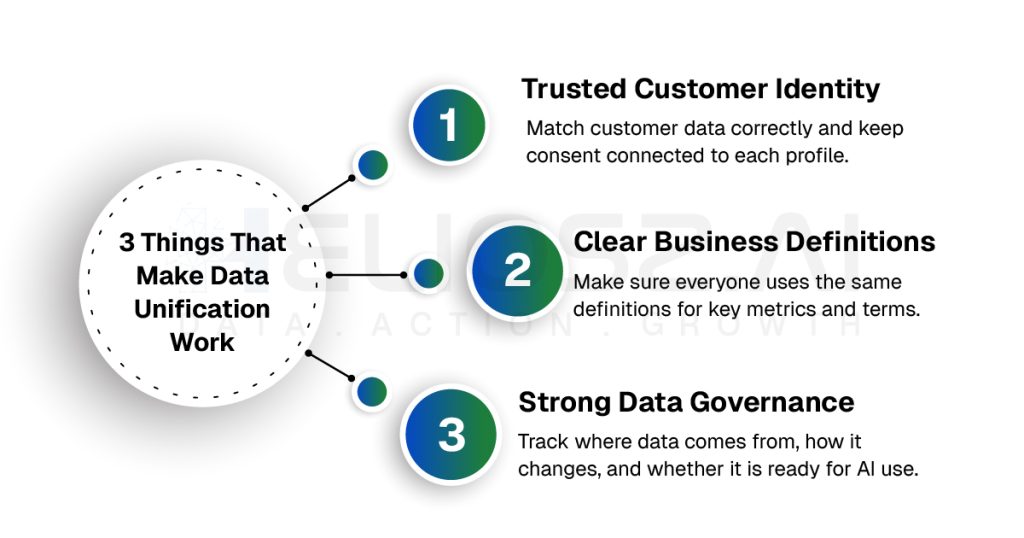
The Three Things That Decide Whether Data Unification Holds
1. Identity Resolution And Customer Data Unification
This is the hardest problem in customer data unification, and it is a business decision wearing an engineering costume. Matching people across advertising, CRM, commerce, loyalty and service data forces a choice between deterministic matching on shared keys and probabilistic matching on behavioral signals, after which someone sets a confidence threshold and writes survivorship rules for when two systems disagree. That threshold belongs on an executive’s desk, because the two failure modes carry very different costs:
- False merge. Two people collapse into one record, and your AI addresses a customer as somebody else entirely. That’s a brand incident, and depending on the jurisdiction, a privacy one.
- False split. One person remains as several records, so reach inflates, frequency capping breaks, and audience size gets quietly overstated to the board.
Regulated industries tend to tune conservatively and accept the fragmentation, while consumer brands usually take some merge risk in exchange for reach. What nobody should do is let that threshold get set by default in a configuration screen.
Consent has to travel with the identity as well. Cross-platform data unification that carries the customer record but leaves consent state and purpose limitation behind is the fastest available route to activating on someone who opted out. Under GDPR, CCPA and India’s DPDP Act, consent is scoped to the purpose for which it was collected, so merging two records does not merge their permissions.
2. Definitions Before Pipelines
One platform calls something a conversion, another calls the same event an opportunity, and a third counts it on a different date in a different currency. Connected data keeps telling conflicting stories until the business agrees what each term means and who owns that definition, which is governance work rather than integration work, and it costs far less to settle before the pipelines are built than after.
This is also what separates a reporting layer from unified business intelligence. When marketing, sales and analytics draw on the same definitions, they stop producing competing versions of the same quarter, and AI stops inheriting the disagreement.
Start with the five metrics that appear in board reporting. If any one of them has more than a single live definition inside the company, that’s the first thing to close.
3. Governance That Survives Contact With Change
New campaigns, markets, systems and customer records arrive continuously, so without clear ownership, validation rules and lineage, drift returns inside two quarters. Your team should be able to answer three things about any number feeding an AI decision:
- Where did it originally come from?
- What transformed it on the way through?
- Does it currently clear the bar for automated use?
Who Owns Marketing Data Unification, And What It Costs
The ownership question stalls more programs than the technology ever does. Marketing owns the use case and the commercial outcome, while IT or the central data office owns the pipelines, lineage and access controls. Shared ownership without a named decision-maker leaves the identity threshold, the metric definitions and the consent rules unresolved while both sides wait for the other to move. Name one accountable owner before the first sprint, with real authority over definitions across both functions.
On cost, a program scoped to a single decision path should run one to two quarters with a cross-functional team rather than becoming a platform migration, and the recurring cost is governance, which behaves like a permanent operating line. Judge the result on operating metrics rather than on completion:
- Identity match rate, and false-merge rate specifically
- Number of competing definitions for your top five metrics (target: one each)
- Time from question asked to trusted answer delivered
- Share of AI recommendations a human overturns on data grounds
Those same metrics tell you whether a unified data platform is earning its license fee, which is a question most enterprises cannot currently answer. Salesforce found that teams who have satisfactorily unified their data are 42% more likely to respond to customers regularly and 60% more likely to use AI agents at scale, but those figures are outcomes of the discipline rather than a substitute for measuring it directly.
The Question To Ask Before The Next AI Approval
Enterprise AI now sits close enough to decisions about customers, budgets and revenue that data quality has stopped being a data-team concern. So before signing off on the next AI investment, put one question on the table:
For the specific decision this system will make, can we name every input, who owns each definition, and how quickly we’d detect it if one of them were wrong?
If that question takes more than a week to answer, the constraint on your AI program isn’t the model. It’s everything sitting underneath it.