Email:
inquiry@heliosz.ai
 Phone: +1 (332) 255-6223



 5 Min Read
Most marketing teams can report exactly what happened last month: how much they spent, how many clicks came in, and how many orders followed. Far fewer can explain why revenue moved, or where next month’s budget should go. Every ad platform grades its own results, and each one claims credit for the same customers.
Marketing intelligence tools close that gap. They pull spend and sales data from every channel into one place, work out what actually caused the change, and point to the next move.
This guide reviews 14 marketing intelligence platforms for 2027, covering what each one does well, which teams it suits, and what it costs.
Quick Comparison for Best Marketing Intelligence Tools
| Tool | Method | Best for | Pricing |
| Optivos by Heliosz.AI | MMM + unified commercial intelligence | Retail, CPG & FMCG, Fashion & Apparel, and Sports | Not disclosed |
| Adobe Marketing Campaign Analytics | MMM + multi-touch attribution | Enterprises on Adobe Experience Cloud | Not disclosed |
| Prescient AI | MMM | DTC and omnichannel ecommerce brands | Not disclosed |
| Circana Marketing Mix | MMM (managed service) | Large enterprises wanting a managed partner | Custom quote |
| Sellforte | MMM + incrementality testing + attribution correction | Omnichannel retailers and fashion brands | From €490/month |
| Recast | Bayesian MMM + geo-lift testing | Fast-growing DTC and consumer brands | Not disclosed |
| Measured | Incrementality testing + causal MMM | Enterprise consumer brands | Quote-based |
| Lifesight | MMM + incrementality testing + causal attribution | Mid-market and enterprise brands, agencies | Quote-based; free pilot |
| WorkMagic | Incrementality testing + attribution + MMM | Shopify and Amazon sellers | Not disclosed |
| Google Meridian | Bayesian MMM (open source) | Brands with in-house data scientists | Free |
| Ruler Analytics | Multi-touch attribution + MMM | Lead-gen, B2B and professional services | Plans based on website traffic |
| Analytic Partners | MMM + commercial analytics | Fortune 500 and multinational brands | Not disclosed |
| Keen Decision Systems | Bayesian MMM | CPG and retail brands focused on forward planning | From about US$25,000 |
| Sigmoid | Cross-channel attribution + AI budget reallocation | Large CPG companies | Not disclosed |
What Are Marketing Intelligence Tools?
Marketing intelligence tools reveal which channels genuinely bring in revenue. They gather ad spend and sales data in one place and estimate how much each source, such as Google, Meta, TV or email, really contributed.
Standard reports only describe what happened. This software goes further by explaining why sales changed and what to do next: which channel to trim, which to scale, and what a new split is likely to deliver.
Most of these platforms rely on one of three methods.
Marketing Mix Modeling (MMM)
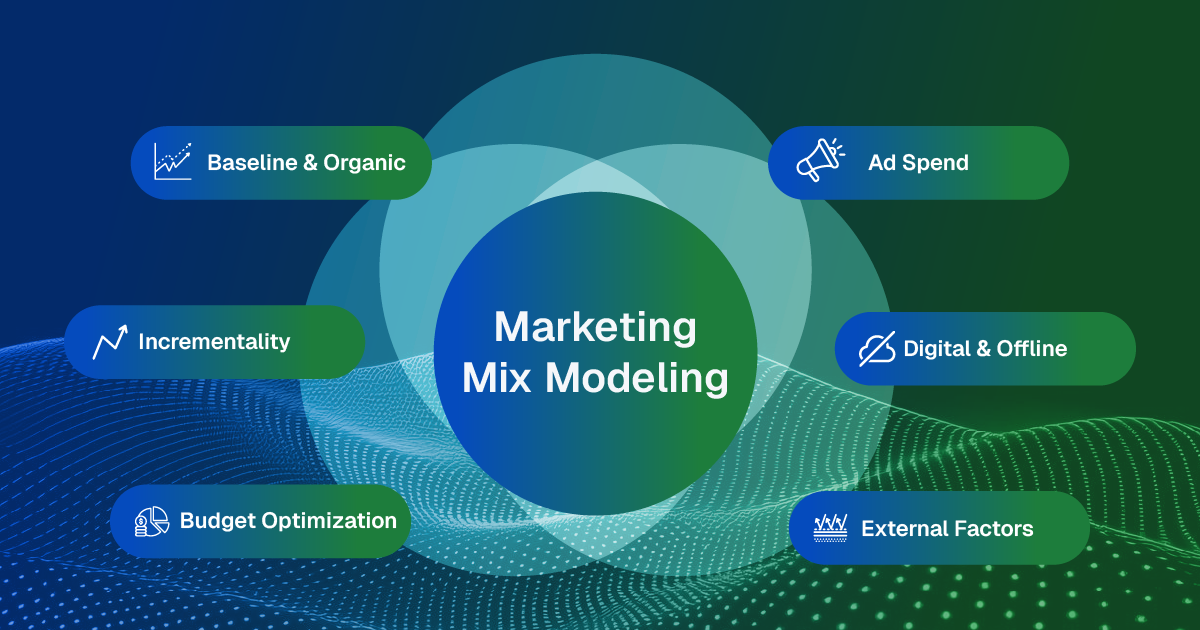
Marketing mix modeling (MMM) is a measurement approach that studies historical sales, spend, pricing, promotions and other business factors to estimate each channel’s contribution. It covers both online and offline media, including TV, without tracking individual customers.
Multi-touch Attribution (MTA)
MTA follows digital interactions such as ad clicks and site visits, then assigns credit to the touchpoints that came before a purchase. It shows which interactions are linked to conversions. However, it sees little of offline channels like TV, and it can’t reliably prove that those interactions caused the purchase.
Incrementality Testing
Incrementality testing measures the extra results a campaign creates. It compares a group that saw an ad with a similar group that didn’t, and the gap between them reveals the true impact. Attribution spreads credit across touchpoints, while a lift test checks whether the campaign produced results that wouldn’t have happened anyway.
How We Picked These Marketing Intelligence Tools
Every product here had to answer one basic question well: did the marketing actually cause the sales, or was it simply present when they arrived?
Click counts can’t settle that, so we included only platforms that use marketing mix modeling, incrementality testing, or cross-channel attribution tied to revenue.
From there, we weighed five further factors:
- Offline coverage: Many brands still invest in TV, print and in-store activity, and a tool that only sees digital will keep pushing money toward digital.
- Data connections: If loading data takes weeks of manual work, the platform won’t get used.
- Budget planning: Teams need to see likely outcomes before moving money, not just afterward.
- Ease of use: Marketers should be able to read the results without waiting on a data scientist.
The 14 Best Marketing Intelligence Tools for 2027
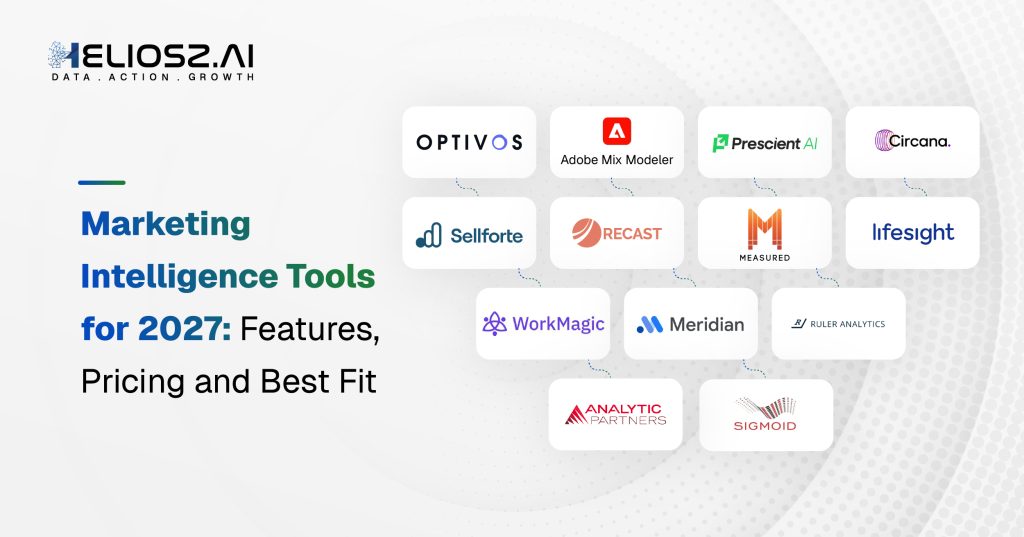
The best marketing intelligence tools for 2027 are Optivos by Heliosz.AI, Adobe Marketing Campaign Analytics, Prescient AI, Circana Marketing Mix, Sellforte, Recast, Measured, Lifesight, WorkMagic, Google Meridian, Ruler Analytics, Analytic Partners, Keen Decision Systems and Sigmoid (Helios). Each review covers the tool’s method, standout features, ideal users, industries and pricing, so teams can quickly shortlist the right fit.
Optivos by Heliosz.AI
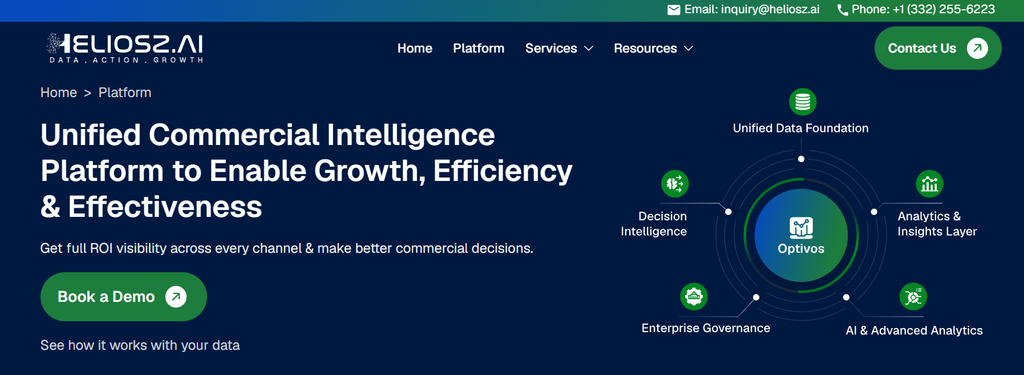
Optivos is the commercial intelligence platform from Heliosz.AI, built for consumer brands in retail, CPG and FMCG, fashion and sports. In these businesses, marketing, pricing, product and distribution data usually live in separate systems.
A sales spike rarely has one cause. A TV burst, a retailer price cut and a new pack size can all land in the same week. Optivos places media beside trade spend, pricing, promotions and demand forecasts to show how much each one contributed.
What stands out
- Measures marketing and commercial drivers in one model. Optivos estimates the contribution of marketing and commercial drivers where sufficient data is available. Its Total Commercial Impact Optimization (TCIO) connects marketing, trade spend and revenue drivers to provide a more integrated view of commercial performance.
- It brings messy data into one place. It connects ERP, CRM, point-of-sale, syndicated, eRetail and financial data. An AI taxonomy sorts activity into POES media (Paid, Owned, Earned and Shared), so every market reports on the same terms.
- It goes beyond media. Teams get SKU- and retailer-level price elasticity, trade and consumer promotion ROI, retail media ROI, and a clear split between true growth and sales shifting between their own products.
- It lets teams test plans before spending. What-if simulations show the likely outcome of a new budget split, and planners can ask questions about ROI or trade-offs in plain English.
- It’s client-owned and expert-led. Brands can run it as hosted software or inside their own environment while keeping full control of their data. Experienced data engineers and domain experts deliver every implementation.
| Method | Marketing mix modeling, unified commercial intelligence |
| Key features | Unified Commercial Data, Marketing Mix Modeling (MMM), Marketing Attribution, Pricing and Revenue Intelligence, Promotion Optimization, Product and Distribution Intelligence, Digital Commerce Intelligence, Demand Forecasting, Data Governance, AI-Powered Insights, Cross-Functional Intelligence. |
| Best for | Consumer brands linking marketing, pricing and revenue decisions |
| Industries | Retail, CPG & FMCG, Fashion & Apparel, Sports |
| Notable clients | Not disclosed |
| Headquarters | USA |
| Pricing | Not disclosed; contact Heliosz.AI for a demo and custom pricing |
Adobe Marketing Campaign Analytics
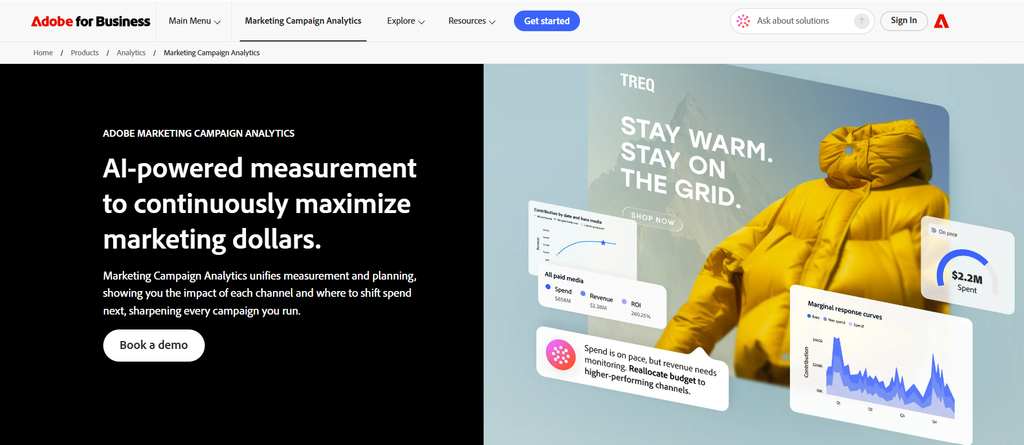
Ask a marketing mix model and an attribution tool the same question, and you’ll often get two different answers. Adobe Marketing Campaign Analytics aims to address this gap. It combines both methods and trains them on overlapping time periods. Attribution results feed into the mix model, while the mix model’s results help calibrate attribution. Adobe calls this approach bi-directional transfer learning.
What stands out
- Annual plans and weekly campaign views stay aligned instead of contradicting each other.
- Although it doesn’t run experiments itself, it can absorb lift-test results from elsewhere to sharpen accuracy.
- Coverage spans paid, earned and owned activity across digital and offline media.
- Outputs connect with Customer Journey Analytics and Journey Optimizer for companies already inside Adobe’s ecosystem.
| Method | MMM + multi-touch attribution |
| Key features | Bi-directional transfer learning, scenario planning, experiment calibration, Adobe integrations |
| Best for | Enterprises already on Adobe Experience Cloud |
| Industries | Not disclosed |
| Notable clients | Not disclosed |
| Headquarters | San Jose, USA |
| Pricing | Not disclosed; licensed by usage volume and add-ons |
Prescient AI
Brands advertising on Meta while selling through Amazon often wonder how much marketplace revenue those ads really drive. Prescient AI specializes in that question by tracking the halo effect one channel has on sales elsewhere. The Miami company now works with more than 100 brands, including Saatva, HexClad and Jones Road.
What stands out
- Prebuilt connectors bring in media data quickly, and the company says first insights arrive within 36 hours.
- Findings go down to individual campaigns rather than stopping at platform totals.
- Scenario planning covers Meta, Google, TikTok and Amazon in one view, with CTV and linear TV included where available.
| Method | Marketing mix modeling |
| Key features | Halo effect analysis, campaign-level insights, prebuilt connectors, scenario planning |
| Best for | DTC and omnichannel ecommerce brands |
| Industries | DTC ecommerce, Marketplaces, Retail |
| Notable clients | Saatva, HexClad, Jones Road, MaryRuth’s, Coterie |
| Headquarters | Miami, USA |
| Pricing | Not disclosed; demo-led |
Circana Marketing Mix (formerly Nielsen MMM)
Plenty of marketers still know this offering as Nielsen MMM. Circana finished acquiring the business in August 2025 and folded it into its media division alongside NCSolutions. The result is a single service that spans media planning, in-flight optimization and post-campaign analysis.
What stands out
- Clients get dedicated analysts who build the models and deliver recommendations.
- Its automated, connected infrastructure is designed to return ROI insights within weeks instead of months.
- Custom simulations help answer planning questions such as what next year’s investment should look like.
| Method | Marketing mix modeling (managed service) |
| Key features | Cross-channel coverage, budget simulations, dedicated analyst support |
| Best for | Large enterprises that want a managed MMM partner |
| Industries | Not disclosed |
| Notable clients | Not disclosed |
| Headquarters | Chicago, USA (Circana) |
| Pricing | Custom quote based on scope, data volume and support level |
Sellforte
Retail revenue rises and falls for many reasons unrelated to advertising, such as a sale weekend, a cold spell or Black Friday. Sellforte, based in Finland, was built to separate those forces from genuine marketing impact. It evaluates stores and ecommerce together, so a TV spot that drives shoppers into a branch still earns credit.
What stands out
- Promotions, weather, seasonality and major retail events are modeled alongside media.
- Recommendations come at three levels: individual campaigns, channel splits and week-by-week pacing.
- Mix modeling, incrementality testing and attribution correction run inside one system, which avoids three conflicting reports.
- Fees begin at €490 per month and grow with media investment, while larger plans add an onboarding charge.
| Method | MMM + incrementality testing + attribution correction |
| Key features | Weekly budget pacing, campaign and channel recommendations, offline media coverage |
| Best for | Omnichannel retailers and fashion brands |
| Industries | Retail, Fashion, Grocery, Ecommerce |
| Notable clients | Azzas 2154, Musti Group, Bonprix, INTERSPORT Germany |
| Headquarters | Espoo, Finland |
| Pricing | From €490/month, scaling with media spend |
Recast
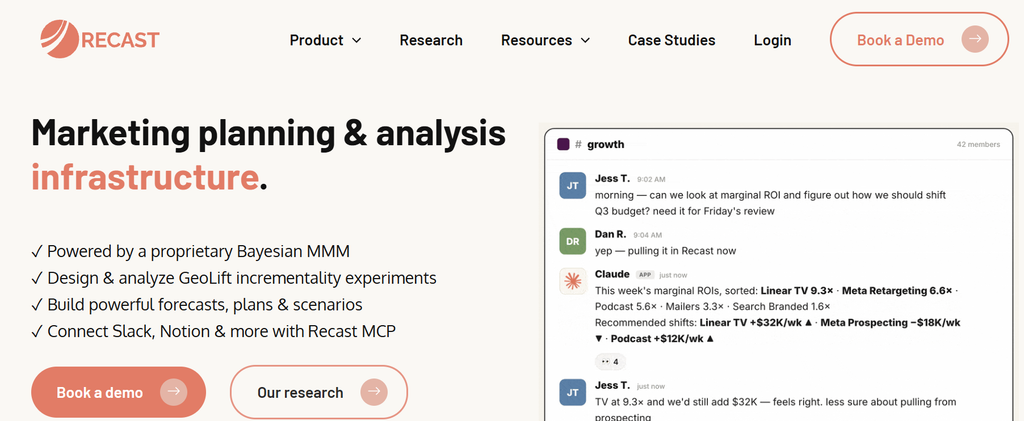
Recast openly tells clients not to trust any vendor’s figures blindly, its own included. Instead of a single tidy ROI number, it shows the uncertainty around each estimate, sends weekly accuracy scorecards and publishes its model documentation. More than 30% of its staff hold PhDs in math or statistics.
What stands out
- Models refresh every week and come with forecasting, optimization and goal-tracking tools.
- Channel performance can shift over time in the model, which matters when a channel is new or losing steam.
- A companion product, GeoLift by Recast, runs regional experiments to validate the model.
| Method | Bayesian MMM + geo-lift testing |
| Key features | Weekly model refresh, uncertainty ranges, time-varying channel ROI, forecasting |
| Best for | Fast-growing DTC and consumer brands that want transparent models |
| Industries | DTC, Ecommerce, Consumer brands |
| Notable clients | Away, Masterclass, Rocket Money, Headspace, LA Times |
| Headquarters | New York, USA |
| Pricing | Not disclosed; no free trial |
Measured
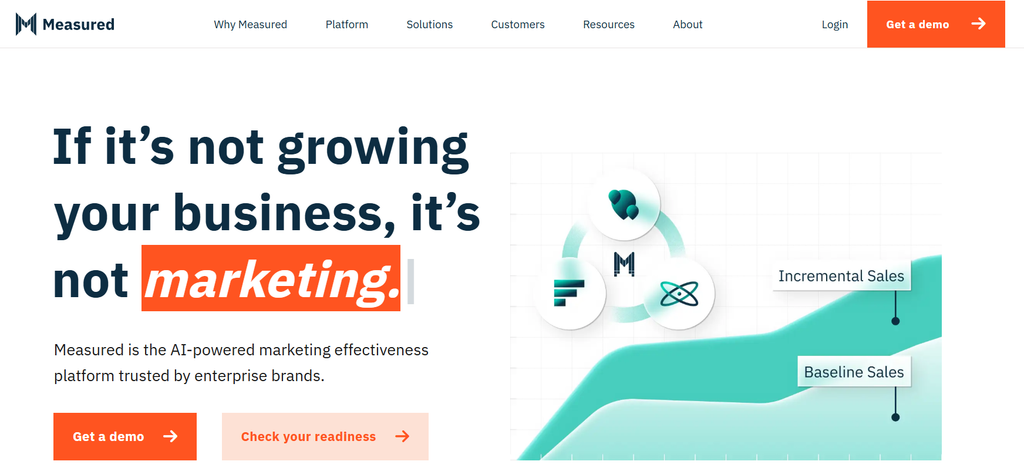
Teams stuck debating whether TV or influencer campaigns work tend to find Measured useful. Its core strength is experimentation: ads pause in some regions, stay live in others, and the resulting sales are compared. Those findings then become starting assumptions inside its mix model, keeping estimates anchored to observed outcomes.
What stands out
- Its database draws on more than 30,000 experiments across over 200 brands, giving new clients a stronger starting point.
- Testing sharpens estimates for difficult channels such as influencers, streaming audio and national linear TV.
- Hundreds of possible test-market combinations are simulated before any regions are chosen.
- Paramount, Unilever and Intuit are among its clients.
| Method | Incrementality testing + causal MMM |
| Key features | Automated geo testing, media plan optimizer, benchmarking |
| Best for | Enterprise consumer brands with large, multi-channel budgets |
| Industries | Consumer brands |
| Notable clients | Paramount, Unilever, Intuit |
| Headquarters | Austin, USA |
| Pricing | Quote-based |
Lifesight
Running separate products for modeling, testing and attribution often leaves teams with three numbers that never match. Lifesight combines all three in one platform, checks them against each other, and adds forecasting, creative intelligence and spend optimization on top. It covers both online and offline media.
What stands out
- An AI agent named Mia answers performance questions and suggests next steps, which saves digging through dashboards.
- One bundled subscription covers modeling, geo tests, adjusted attribution and reporting, and a free pilot is available.
- Its client roster has included Publicis Groupe, GroupM, McDonald’s and Honda.
| Method | MMM + incrementality testing + causal attribution |
| Key features | Geo experiments, scenario planner, AI agent (Mia), creative intelligence |
| Best for | Mid-market and enterprise brands and agencies |
| Industries | Ecommerce, Retail, CPG, Consumer services |
| Notable clients | Publicis Groupe, GroupM, McDonald’s, Honda |
| Headquarters | Singapore |
| Pricing | Bundled annual subscription; quote-based, free pilot available |
WorkMagic
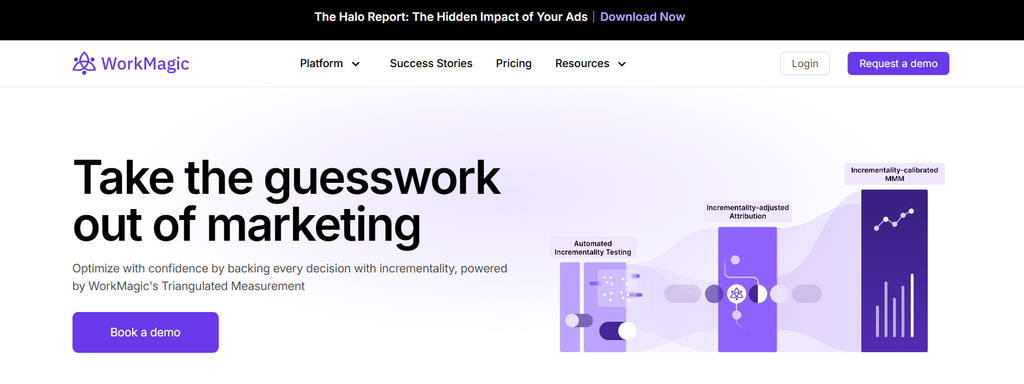
WorkMagic’s co-founder and CEO previously led growth at TikTok Ads, which helps explain its focus on fast-moving online sellers. The platform runs regional lift tests automatically and feeds the results into both its attribution and its mix model. As a result, one experiment can improve estimates even for channels that were never tested directly.
What stands out
- The company says its lift tests can deliver clear readings in about three weeks, compared with the months traditional studies often need.
- Setup requires no code and links with Shopify, Amazon and major ad networks.
- Profit appears by channel, campaign and individual SKU rather than as revenue alone.
- Coverage reaches beyond DTC to Amazon, retail and wholesale sales.
| Method | Incrementality testing + attribution + MMM |
| Key features | Automated geo holdout tests, incrementality-calibrated attribution and MMM, SKU-level profit analysis |
| Best for | Shopify and Amazon sellers |
| Industries | Ecommerce |
| Notable clients | Not disclosed |
| Headquarters | USA |
| Pricing | Not disclosed; contact sales |
Google Meridian

Cost is the first reason most teams consider Meridian, because Google released it free as open-source code. Brands install and operate it themselves. It works on aggregated data without cookies or user tracking, accepts calibration from your own experiments, and can tune ad frequency using reach and frequency inputs.
What stands out
- There is no license fee, so expenses come down to staff time and computing.
- Every assumption in the model is visible and editable.
- Scenario planning runs through Google Colab and Data Studio.
- It runs in Python and performs best with roughly two to three years of weekly history, which suits companies that employ data scientists.
| Method | Bayesian MMM (open source) |
| Key features | Experiment calibration, reach and frequency optimization, scenario planning |
| Best for | Brands with an in-house data science team |
| Industries | Not disclosed |
| Notable clients | Not disclosed |
| Headquarters | Mountain View, USA (Google) |
| Pricing | Free |
Ruler Analytics
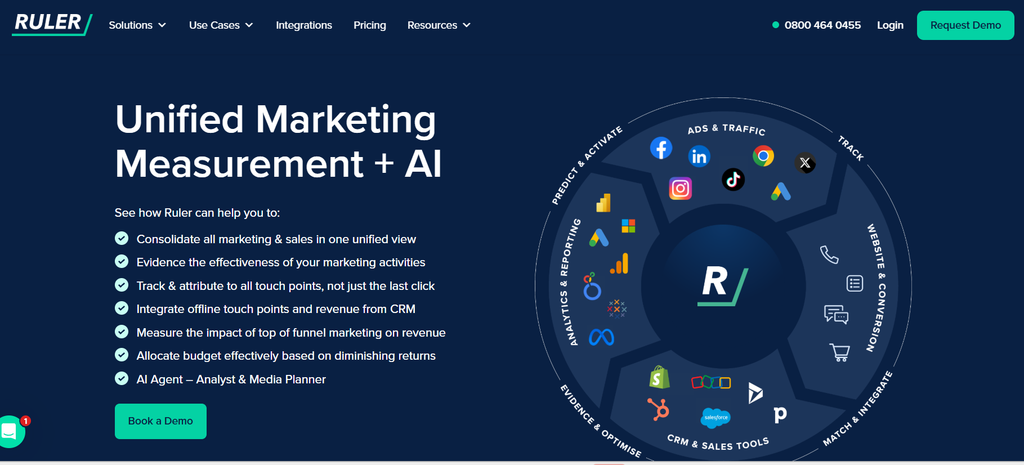
Many purchases still begin with a phone call or a contact form, and most ad platforms lose track of them. Ruler Analytics connects calls, forms, live chats and offline deals to their original marketing source, then matches each one to revenue recorded in the CRM.
What stands out
- Impression modeling links ad views to later conversions, giving display, video and offline media credit even without a click.
- Its mix model adjusts for saturation and platform bias, so allocation decisions can be based on marginal ROAS.
- Revenue data flows back into Google Ads and Meta, so their algorithms optimize toward sales rather than leads.
- Each plan includes a dedicated customer success manager and white-glove onboarding.
| Method | Multi-touch attribution + MMM |
| Key features | Call and form tracking, impression modeling, CRM revenue matching, budget optimizer |
| Best for | Lead-gen businesses, B2B and professional services |
| Industries | SaaS, Professional services, and other lead-gen sectors |
| Notable clients | Not disclosed |
| Headquarters | UK |
| Pricing | Four plans; MMM requires the Advanced plan |
Analytic Partners
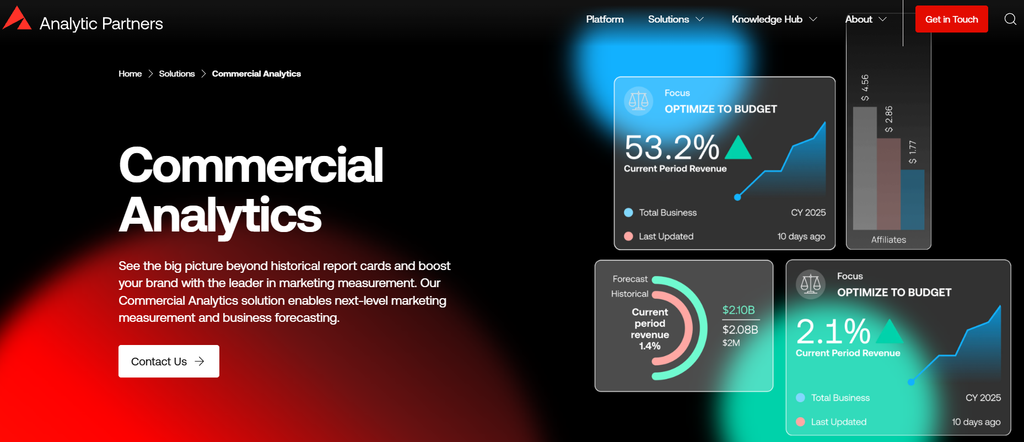
Analytic Partners practiced marketing mix modeling well before its recent comeback. Founded in 2000 and headquartered in Miami, the firm serves clients in more than 50 countries. Its GPS Enterprise platform handles the full cycle, from data ingestion through modeling, forecasting, optimization and scenario planning.
What stands out
- Its analysis reaches beyond media into finance, supply chain and other business functions.
- Gartner named it a Leader in the 2025 Magic Quadrant for MMM Solutions, and Forrester did the same in a 2026 Wave report.
- Its ROI Genome product draws on benchmarks gathered over 25 years.
- Consultants work alongside the software, an approach that suits multinational organizations.
| Method | MMM + commercial analytics (platform + consulting) |
| Key features | GPS Enterprise, ROI Genome benchmarks, scenario planning |
| Best for | Fortune 500 and multinational brands |
| Industries | Not disclosed |
| Notable clients | Not disclosed |
| Headquarters | Miami, USA |
| Pricing | Not disclosed; enterprise contracts |
Keen Decision Systems
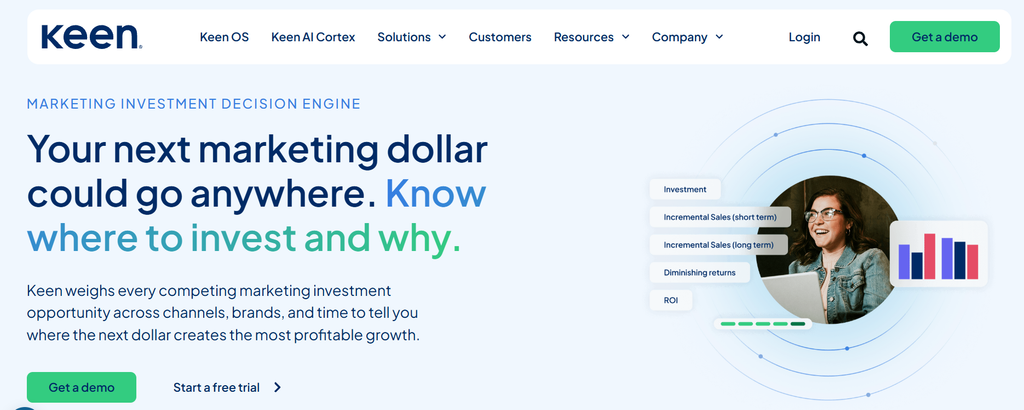
Keen Decision Systems was founded in 2010 and builds Bayesian marketing mix models. It pairs each client’s data with more than 40 years of research and a decade of metadata, so planners don’t start from a blank page. The company reports that more than 450 brands use its platform.
What stands out
- The platform predicts future revenue performance for each channel, so a plan can be judged before money moves.
- Planning and optimization happen by channel and by week. One reviewer described this as a big improvement over the once-a-year conversation that traditional mix modeling produced.
- Keen’s team runs the data, modeling and planning work as a managed service, and it also trains client staff to use the platform on their own.
- Brands such as Post, Church & Dwight, 3M and Smithfield Foods have used it.
| Method | Bayesian MMM (platform + managed service) |
| Key features | Revenue forecasting, weekly channel planning, scenario simulation, budgeting |
| Best for | CPG and retail brands focused on forward planning |
| Industries | CPG, Retail, Travel, B2B, Quick-service restaurants |
| Notable clients | Post, Church & Dwight, 3M, Smithfield Foods |
| Headquarters | North Carolina, USA |
| Pricing | Starts at about US$25,000, according to software directory listings |
Sigmoid

Sigmoid is a data engineering and AI company, and Helios is its AI-powered marketing platform. Helios sits on a single governed layer called the Global Marketing Data Hub, which gathers brand content, performance signals, compliance rules and cross-channel attribution data. Five purpose-built AI engines then handle asset generation, regulatory review, campaign activation, attribution and budget reallocation.
What stands out
- Creative, compliance and campaign analysis share one data foundation, which removes hand-offs between separate tools and agencies.
- In one case study, a global health, hygiene and nutrition company replaced half-yearly third-party attribution reports with ongoing analysis and budget reallocation.
- Sigmoid has worked with more than 25 Fortune 500 companies, mainly in CPG, retail, financial services and life sciences.
| Method | Cross-channel attribution + AI budget reallocation |
| Key features | Global Marketing Data Hub, AI asset generation, regulatory review, campaign activation, budget reallocation |
| Best for | Large CPG companies wanting creative, compliance and campaign analysis on one platform |
| Industries | CPG, Retail, Financial services, Life sciences |
| Notable clients | Not disclosed |
| Headquarters | USA |
Closing Thoughts
Last month’s figures are easy to pull up. The harder part is understanding why revenue shifted and what to change next, and that is the job the right marketing intelligence tool should take on for your team.
To narrow down the list, try this. Share two to three years of historical marketing spend and sales data with two or three vendors, depending on the model’s data requirements. Ask each one where they would move 10% of your budget and why. How each vendor responds, and how clearly they explain their recommendations, will help you identify which tool fits the way your team works.
If pricing and promotions influence your sales as much as media does, see how Optivos by Heliosz.AI handles the same exercise with your data.
FAQs
What are marketing intelligence tools?
Marketing intelligence tools combine spend and sales data from every channel to show which activities genuinely produce revenue. They explain why results went up or down and recommend where to shift investment next. Most rely on mix modeling, attribution, lift testing, or a blend of the three.
How are marketing intelligence tools different from marketing analytics tools?
Analytics products mostly report what happened, such as clicks, visits and conversions. Marketing intelligence software estimates what caused those outcomes, separates marketing’s effect from factors like seasonality or price changes, and supports future planning through scenario testing.
How much does marketing intelligence software cost?
Prices vary widely. Google Meridian is free but requires a data science team. Sellforte starts at €490 a month, and directory listings put Keen’s entry price at about US$25,000. Enterprise providers like Analytic Partners and Circana negotiate custom contracts, while most other vendors quote based on media spend and scope.
How much data do you need to get started?
The requirement depends on the method. Mix modeling relies on historical spend and sales records, and Google Meridian, for example, works best with roughly two to three years of weekly figures. Lift tests need far less history; WorkMagic says its experiments can produce clear readings in about three weeks.
Should you choose MMM, attribution or incrementality testing?
Each approach answers its own question. MMM suits long-range planning across online and offline media. Attribution guides daily digital campaign decisions. Lift testing confirms whether a specific campaign truly generated extra sales. Many organizations use more than one, which is why several platforms on this list combine them.